AM3500
 
AM35xx Synchronous Servomotors

AM35xx | Synchronous Servomotors

New motor technologies enable more and more dynamic motors with lower inertia. The aim of most motor development efforts is to generate more torque with a design that should be as compact as possible. The challenge is that loads to be moved do not reduce proportionally – on the contrary, with each machine generation the trend is towards higher loads. Motor design initially involves calculation of the torque, which means that the mass inertia ratio has to be determined. The mass inertia ratio can be calculated from the quotient of reduced load moment of inertia and rotor moment of inertia of the motor.

For highly dynamic applications this ratio should not exceed 5:1; for ratios exceeding 10:1 the motor design should be reconsidered. The CYMEX design software makes calculation of the external inertia particularly easy. The mass inertia ratio is automatically considered as soon as a motor is selected.

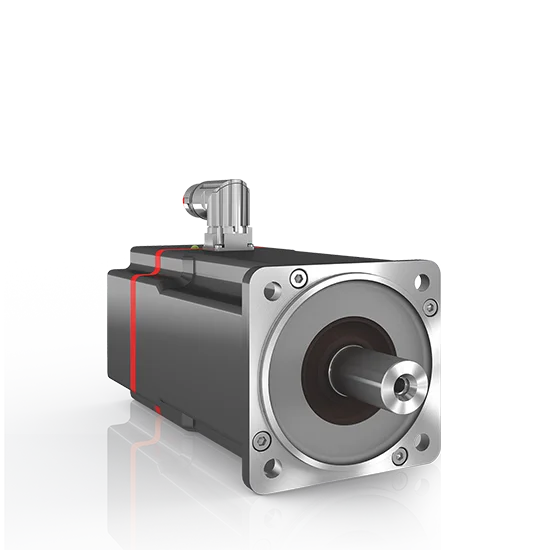
For improving the inertia ratio, it may be advisable to introduce gearing or to increase the gear ratio for existing gearing, since the reduction in load moment of inertia is proportional to the square of the gear ratio. However, the resulting lower speed/velocity is often unsuitable, leaving selection of a larger motor as the only solution. Beckhoff presents the new AM3500 motor series in order to avoid the associated higher costs for the motor and servo controller. These motors are particularly suitable for highly dynamic applications with high loads. In conjunction with higher rotor inertia, they offer the same benefits as the AM3xxx motor series in the form of the pole-wound stator winding, which significantly reduces the overall size. The flanges, connectors and shafts of the new range are compatible with the tried and tested AM3000 motors. The new models are available with flange sizes 3 to 6 and torques between 1.9–15 Nm. The rated speed range is 3,000–6,000 rpm. Resolvers or absolute encoders (single or multi-turn) are available as feedback system. The standard protection class is IP 64; IP 65 is available as an option.


Features

AM35uv-wxyz Standstill torque Standstill current Rated torque Rated current Rotor moment of inertia (without brake) Rotor moment of inertia (with brake)
AM3541-w0yz 1.9 Nm 1.7 A 1.6 Nm 1.5 A 2.0 kg cm2 2.2 kg cm2
AM3541-w1yz 1.9 Nm 2.8 A 1.2 Nm 1.9 A 2.0 kg cm2 2.2 kg cm2
AM3542-w0yz 3.3 Nm 2.4 A 2.9 Nm 2.3 A 4.0 kg cm2 4.2 kg cm2
AM3542-w1yz 3.3 Nm 4.5 A 2.1 Nm 3.1 A 4.0 kg cm2 4.2 kg cm2
AM3543-w0yz 3.1 Nm 3.0 A 3.0 Nm 2.3 A 8.0 kg cm2 8.2 kg cm2
AM3543-w1yz 3.1 Nm 5.2 A 1.9 Nm 2.7 A 8.0 kg cm2 8.2 kg cm2
AM3551-w0yz 4.1 Nm 3.4 A 3.2 Nm 2.8 A 15.0 kg cm2 15.6 kg cm2
AM3551-w1yz 4.1 Nm 6.1 A 1.7 Nm 2.9 A 15.0 kg cm2 15.6 kg cm2
AM3552-w0yz 6.3 Nm 4.8 A 4.6 Nm 3.6 A 19.0 kg cm2 19.6 kg cm2
AM3553-w0yz 8.6 Nm 6.4 A 6.1 Nm 4.8 A 20.0 kg cm2 20.6 kg cm2
AM3562-w0yz 11.6 Nm 10.3 A 8.4 Nm 7.9 A 40.0 kg cm2 42.0 kg cm2
AM3563-w0yz 14.9 Nm 12.5 A 10.9 Nm 9.6 A 60.0 kg cm2 62.0 kg cm2


u: flange code

v: motor length


Option w = 0: smooth shaft

w = 1: shaft with groove and feather key according to DIN 6885


Option x = 0: rated speed 3,000 min-1

x = 1: rated speed 6,000 min-1 (only till AM3551)


Option y = 0: resolver, 2-pole

y = 3: single-turn absolute encoder, Hengstler BiSS

absolute position within one revolution,

electronic identification plate, 2,048 sine periods per revolution

y = 4: multi-turn absolute encoder, Hengstler BiSS

absolute position within 4,096 revolutions,

electronic identification plate, 2,048 sine periods per revolution


Option z = 0: without stopping brake

z = 1: with stopping brake


Special flange, special shaft and other accessories on request