CNC machining center for window and door manufacturing powered by PC-based control and EtherCAT
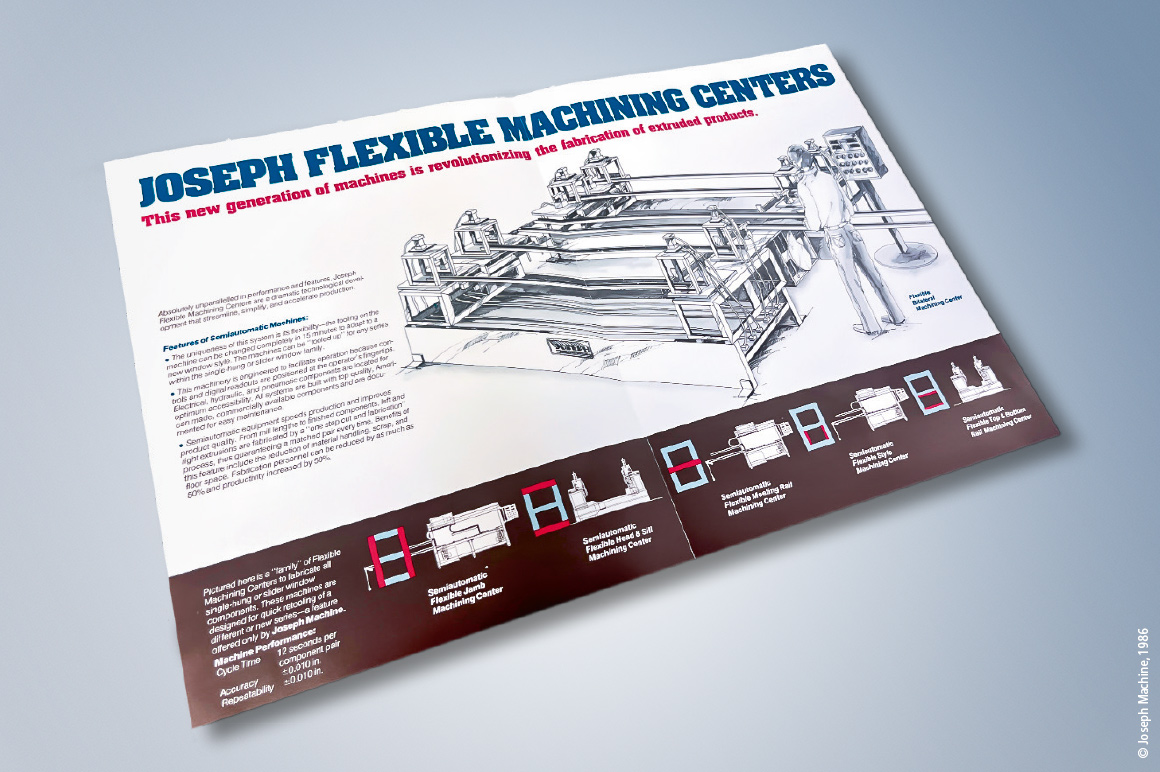
Engineers often channel their best ideas into a sketch. When Joseph Machine Company printed its first brochure in 1986, the company laid out an ambitious machine concept in a drawing: a flexible window and door profile machining center capable of adapting to new production needs without rebuilding the machine from the ground up. Eventually, it was PC- and EtherCAT-based control technology from Beckhoff that allowed the OEM to realize their 40-year vision.
Joseph Machine’s core business is straightforward in description but complex in execution. “Our ‘start to finish’ solutions can cover every aspect – from fabrication, cutting, punching, welding, glazing, hardware insertion, and cleaning to cost-effectively assemble window and door frames made of PVC, fiberglass, or aluminum in under 60 s,” says Tom Vajdic, Vice President of Sales at Joseph Machine.
While these tasks must be executed at speed, the machines must maintain precision and the ability to rapidly changeover materials, product types, and process flows. “For decades, machines were configured for the product the end users knew they’d make for the next several years,” Anthony Pigliacampo, owner and CEO of Joseph Machine, adds. “That’s no longer the case. End users need truly flexible machines that can be retooled and reprogrammed quickly as new products are developed.”
Limiting factor: conventional automation
The problem, Joseph Machine found, was that the automation system was often the limiting factor for the desired level of flexibility. Traditional motion control systems forced designers into complex fixed mechanical solutions and made coordinated multi-axis motion difficult, slow, or unreliable.
With those constraints in mind, Joseph’s engineering team set strict parameters for selecting a new control platform: it had to offer high-performance, tightly coordinated motion for potentially hundreds of axes; it had to support a single software engineering environment up and down the control stack; it had to simplify commissioning, wiring and service; and it had to be open to freely integrate third-party sensors and devices. After an evaluation in 2022, Joseph Machine locked in on a solution. “We evaluated many manufacturers, and Beckhoff checked all the boxes,” Tom Vajdic says. After building an internal testbench and proving concepts, Joseph ramped up to a 32‑axis, jFlex SFMC fab center with four independent CNCs and dual pushers by Q3 of 2024.
A new control stack layered with flexibility
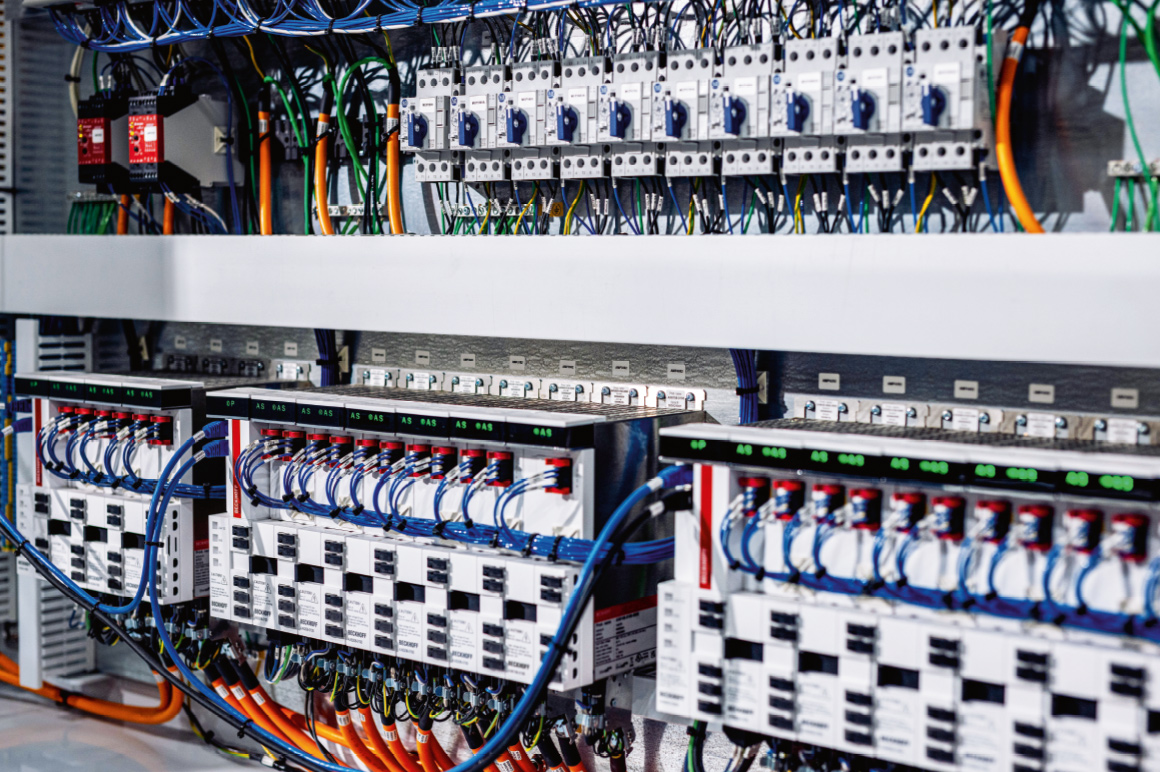
Joseph Machine’s new machines such as the jFlex and the jFlow PVC welder/cleaner are now based on Beckhoff’s PC-based controls and EtherCAT for all areas of automation and motion control. On simpler machines with fewer axes, the company uses CX7000 Embedded PCs with Arm® Cortex®-M7 and integrated I/Os. For high-end applications, Beckhoff’s fanless C6025 ultra-compact Industrial PCs with processors up to Intel® Core™ i7 (four cores) provide the necessary computing power to run complex, many-axis motion on machining centers.
There is no communication bottleneck for the controls as EtherCAT delivers deterministic, high‑speed communication and synchronization across dozens of axes and distributed I/O. Beckhoff’s openness to multiple protocols and EtherCAT’s broad industry support have been major enablers.
The Joseph Machine team found additional benefits in the IP67 rating of the machine mountable EtherCAT Box modules. Beyond that, EtherCAT P reduces wiring complexity with One Cable Automation. “Our move to EtherCAT P cut our cabling by roughly 50% and eliminated laborious field wiring,” Albert Arustamyan, Controls Engineering Manager at Joseph Machine, says.
As the motion control aspects of the new machines were mission critical, Joseph Machine embraced Beckhoff’s drive technology such as the AX8000 family of servo drives and AM8000 series servomotors with One Cable Technology (OCT) paired with Beckhoff AG series gearboxes. The AX-Bridge quick connection technology to feed power through to all connected servo drive modules meant the OEM could substantially reduce the wiring and number of required fuses compared to the previous drive system. Additionally, energy-saving AA30x3 electric cylinders allowed Joseph Machine to replace power-hungry hydraulic and pneumatic solutions, most notably in punching processes that were historically hydraulic.
Joseph Machine has also begun implementing distributed motion control technology with AMI8100 series compact integrated servo drives. This series combines a servomotor, servo drive, and fieldbus connection. The drives, suitable for the low voltage range up to 48 V DC and power ratings up to 400 W, can be placed directly on the machine.
Beyond the hardware, TwinCAT 3 automation software delivered additional engineering efficiencies. With many Joseph machines requiring dozens of axes of motion control, TwinCAT 3 NC PTP is used to cover development for the large number of axes per machine. The company’s software engineers gravitated to structured text programming and TwinCAT motion libraries, kinematics, and camming. TwinCAT Motion Designer tools allow the entire software team to specify and configure different drives, motors, and other components without requiring a core motion specialist to do all the work.
The ability to write modular, re‑useable code blocks and apply CNC paths with variables rather than recreating code across hundreds of locations changed how the company approaches machine development. “Now we can do coordinated, interpolated motion that’s smooth and precise, and if we need to change a radius or a start point, we edit it once in the G code and it takes effect on every fabrication the machine performs,” Albert Arustamyan says. “TwinCAT code reusability from machine to machine allows us to focus more on software development, so we can introduce more exciting feature extensions.”
The most visible performance enhancement is in the motion capabilities: Joseph can now execute truly simultaneous, overlapping process steps and tool actions that were previously sequenced serially. The platform supports concepts like “tied tooling,” where multiple tools hit a dimensional location simultaneously, and multi‑track operations that process multiple parts at once – enabling impressive throughput gains without sacrificing product quality.
The 40‑year vision, realized
With the jFlex SFMC and jFlow, Joseph Machine has translated a long‑held ambition from paper to the plant floor. These machines give window and door manufacturers equipment that is reliable, reusable, and adaptable for high-throughput production. “High-speed, coordinated motion from Beckhoff is crucial for successfully introducing such powerful new machines,” Albert Arustamyan says.
The simplification of commissioning and the decentralized approach using IP67-protected components have created positive ripple effects across Joseph Machine’s business. Labor, commissioning time, and cabinet size have all been reduced. “By minimizing cables, terminal blocks, and real estate from machine mountable EtherCAT Box I/O and drive technology, we have been able to downsize electrical cabinets by an estimated 15 to 20%,” Albert Arustamyan says.
Anthony Pigliacampo summarizes: “We’re very happy that we chose this path – working with Beckhoff feels like a true partnership and an extension of our team. Our machines are now built with the right building blocks for the future of flexible machining – and ultimately that’s a game‑changer for our customers.”


