Modernized building and event technology at the Ferry Porsche Congress Center
The Ferry Porsche Congress Center (FPCC) in Zell am See, Austria, has undergone continuous, forward-looking modernization, offering immense benefits for both the operator and customers of the event center. The flexible and – at the same time – extremely easy-to-use building functionality and event technology, together with a high level of energy efficiency, results in unprecedented efficiency and future viability when it comes to operation. It was implemented by Vienna-based company Salzgeber GmbH with Beckhoff technology.
For Oliver Stärz, CEO of the FPCC, the Porsche brand stands for sport, fun, and flexibility – and the same is true of the character of the Ferry Porsche Congress Center: with perfectly coordinated technology and a high degree of individuality in use. The event center was opened in 2007 and even then was designed holistically and with a focus on functionality and usability for the customer. As Stärz explains, the operator is explicitly committed to the topics of future viability, energy efficiency, and sustainability in the meetings and congress industry: “As a certified green meetings and green events company, collaboration with customers is particularly important to us. This saves time and effort, as in-house experts provide comprehensive support and sustainability reports can be created efficiently.”

Key features of the FPCC include a usable floor space of 2,100 m2 and 1,600 m2 of open space as well as 400 underground parking spaces. A total of eight units for flexible use – 20 room variants in total – are available, accommodating a maximum of 1,200 people, i.e., 20 to 800 per room. The building is equipped with 787 m2 of photovoltaic panels with 160 kWp and around 500 lamps that have been converted from halogen to advanced LED technology, achieving energy savings of approx. 74% compared to conventional light sources. Salzgeber relied on PC-based control from Beckhoff to provide a flexible foundation, i.e., one that would be easy to expand and modernize, for building services control and efficient energy use.
The event center awaits its users
On account of the building’s ease of use and flexible usage options, Oliver Stärz sees major benefits for everyone involved: “Both for us as the operator and for our customers. This is because we are able to respond to new usage requirements ourselves with little effort and customers can have their individual ideas implemented in the best possible way – and even make changes during events themselves if necessary. Added to this is the increased energy efficiency, which, firstly, provides positive cost effects in operation and, secondly, is increasingly demanded by customers.”
Tino Pfeifer, senior project engineer at Salzgeber, adds: “Usability that is as simple as possible for the customer can be visualized as follows. The building and its entire infrastructure ‘knows’ which event is taking place, which specific requirements and customer requests have to be met, based on the booking, the occupancy, and the presence of people detected by extensive sensor technology.” And the flexible and powerful building automation system has another effect for Oliver Stärz: “The high degree of automation that could be achieved with the Salzgeber solution and PC-based control from Beckhoff reduces the need for technical specialists such as lighting and sound technicians, as relevant expert knowledge is stored in the software.”
Control technology facilitates modernization and greater sustainability
As an open, modular, and integrated control system, PC-based control from Beckhoff perfectly supports operation of the building in terms of functionality, energy efficiency, and continuous expandability, according to Tino Pfeifer: “The powerful building automation functions made it possible, for example, to implement comprehensive multimodality in the event center. As a result, walls can be moved to create custom room variants, and the system detects these changes and automatically controls sound system, heating, ventilation, etc. efficiently and without manual intervention.”
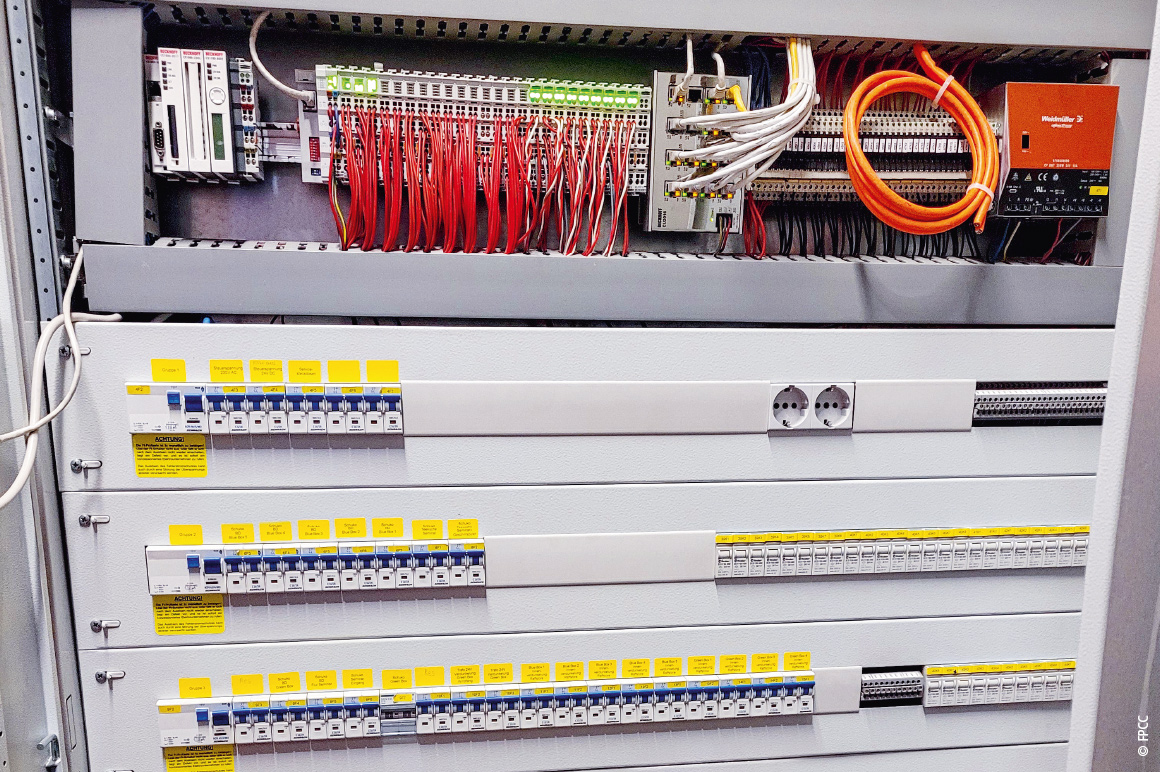
The complexity of the building automation system becomes obvious from the shere number of around 5,800 data points alone, which are used, for example, to integrate the lighting (including around 400 DALI lights), shading, HVAC, and multimedia technology. This is implemented with a C6030 ultra-compact Industrial PC, ten multi-touch control panels as operating stations, the I/O level with eight BK9050 Ethernet TCP/IP Bus Couplers, CU2016 Ethernet switches, and numerous KL series Bus Terminals. In addition, there is TwinCAT 3 automation software, which Salzgeber uses throughout its building and industrial automation projects and which, in the case of the FPCC, is also used to control all subordinate systems such as audio processors, video routers, PTZ (pan, tilt, zoom) cameras as well as KNX and DALI components. The focus here is on functions provided by TwinCAT 3 HMI, Database Server, XML Server as well as Modbus TCP, TCP/IP, IoT Communication (MQTT), IoT HTTPS/REST, and AES70 (OCA).
Oliver Stärz also sees the benefits of PC-based control for continuous building development: “The FPCC has now been around for almost 20 years. And although requirements are constantly changing – for example, due to photovoltaic integration and modernized lighting – as an operator, we are not tied to one system integrator. The Beckhoff system can easily be developed further by any system and programming partner, even in the long term, and its openness to building maintenance means it can easily take changing requirements into account.” Stärz confirms that there is a lot of potential for innovation here with regard to the comprehensive future prospects of the FPCC as a prime example of a sustainable, resilient, and future-oriented building: “The built-in automation solution is not just a means to an end, but a strategic instrument for implementing the vision of the FPCC as an energy-efficient, durable, and smart event center.” The focus is on:
- modularity and expandability as a principle of sustainability
- energy self-sufficiency as a goal
- blackout prevention and resilience strategy
- intelligence through data and thus the path to the digital building twin
- unique selling point through smart sustainability
He adds that this will create a “living infrastructure” instead of a rigid structure. The FPCC’s building automation is therefore not a static system, but a life cycle-capable backbone that evolves with the requirements of users, integrates technological trends such as smart grids, IoT, and digital twins, and actively shapes future topics such as resilience, self-sufficiency, and sustainability.
Software-based implementation of modernization measures
From the FPCC’s point of view, Salzgeber’s main achievement was the programming and renewal of the software applications right across the event center. Very little hardware needed to be replaced for switching from analog to digital data transmission. This concerned the conversion of the video and audio data as well as the integration of the existing building management and lighting systems and services. With this in mind, existing structures were recorded or renewed, legacy media control systems as well as audio DSPs and video routers were replaced, analog video cables (RGBHV) were swapped for 6G-SDI cabling, image mixers were integrated, and control of the general lighting, dimming, and shading was incorporated into the media control system.
Tino Pfeifer summarizes the result for the customer: “The user is handed a laptop that is easy to use. There are three versions – for technicians, for office staff, and for the end customer. The end customer is therefore also able to control and monitor their booked space in the simplest possible way. This is made possible by the end-to-end Beckhoff technology, which allows all equipment and systems in the building to be combined in a simple, user-friendly interface and enables a wide range of background processes to run automatically.”
Among the technical benefits of PC-based control, Pfeifer cites future-proofing, durable hardware, and very long product cycles as well as the advantageous Windows and IT-related architecture. He also adds that the Beckhoff hardware, which remains compatible and available on a long-term basis, enables necessary adjustments to be made even after many years of operation. What’s more, it has always been possible to adapt the modular Beckhoff technology to requirements without ever reaching system limits.
FPCC: Energy efficiency
- 500 LED lamps reduce energy consumption by 74% compared to conventional light sources.
- The photovoltaic system on the roof with a total area of 787 m² provides 160 kWp and could cover the energy requirements of around 60 households.
- Due to the intelligent consumer concept, the FPCC is able to use almost 50% of the energy generated itself.
- Groundwater extraction for cooling purposes in the building works efficiently.
- Complete air exchange across the entire building is possible in just 10 minutes.
- The opportunities presented by the new Austrian Electricity Industry Act (ElWG) 2025 are to be exploited through the provision of controllable load or energy storage, in-house energy generation and grid compliance, access to real-time consumption data, and participation in or the establishment of energy communities.
Further information


