The operation and maintenance of modern wind turbines incurs considerable costs. To maintain competitiveness, failure risks must be minimized, maintenance costs lowered and the availability and energy efficiency of the system increased. This is where condition monitoring enters the game: monitoring of gear units and generators is generally recommended, not just for offshore wind turbines or systems in remote regions.
Beckhoff combines the powerful processors of modern PC technology together with EtherCAT as fast communication system, integrating condition monitoring functionality seamlessly into the controller. The vibrations of bearings or electrical machines are picked up by standard measurement terminals from Beckhoff and transmitted to the controller via EtherCAT. Configuration, programming and diagnostics are carried out within one system using TwinCAT. With improved error detection and holistic system analysis capabilities, the control system-integrated condition monitoring from Beckhoff is superior to conventional hardware-based condition monitoring solutions. Through integration of further signals from operational management, including temperature, pressure and current, among others, false alarms can be prevented and error detection is improved. Integration of condition monitoring into the central PC-based controller is advantageous, in particular where large amounts of data from different devices need to be analyzed or if damage frequencies need to be evaluated in relation to the rotary speed. The controller acquires and processes the signals in the microsecond range.
However, cost reductions with regard to system, installation and maintenance also highlight the merits of system-integrated condition monitoring. Existing systems can be retrofitted simply and inexpensively.
System-integrated condition monitoring offers:
- time-synchronous data logging in << 1 μs
- reliable data analysis
- enhanced diagnostics
- increased system availability
- longer service life of wind turbines
- reduced maintenance costs
- reduced system costs
- enhanced competitiveness

Beckhoff technology highlights for condition monitoring

Implementation of control-integrated or separate condition monitoring solutions based on Beckhoff hardware and software components
The modularity of the Beckhoff hardware and software allows a stand-alone condition monitoring system (CMS) to be set up, as well as the direct integration with the operational management of the wind turbine. In both application scenarios, the identical hardware and software modules can be used.
The universal and scalable portfolio of industrial PCs and embedded PCs enables the flexible choice of the controller: from the single-chip system through to the multi-core server CPUs. Depending on the required performance and adapted to the budget and complexity of the task, a tailored device can be selected. Combined with the EtherCAT I/O modules that can be modularly used, the hardware for a stand-alone CMS is put together. When it comes to integration with the operational management, the individual I/O modules are simply inserted in the EtherCAT segment.
The condition monitoring software modules in the TwinCAT 3 automation software can be linked with the I/O modules and operated independently or combined with the modules for the operational management and integrated in these. In this way, specially developed TwinCAT modules can be used in a wide variety of scenarios, freely combined with each other and easily reused as required. This applies regardless of the hardware; the TwinCAT modules can thus be used on the different industrial PCs and embedded PCs as well as in combination with the I/O modules or various measurement modules.
When retrofitting a wind turbine with condition monitoring, it is only necessary to expand the turbine controller by a terminal block with the appropriate EtherCAT measuring terminals: The EtherCAT measurement modules from the ELM device series provide high-precision, fast, and robust measurement technology, which is directly integrated in the control system. Strain gauges (SG) among other things can be evaluated using the ELM modules. The EL3751 EtherCAT Terminal provides a multi-functional input for analog measurement technology. The EL3632 enables the direct connection of various acceleration sensors via an Integrated Electronics Piezo-Electric interface (IEPE) and performs the high-precision vibration measurement. The raw data are recorded synchronously (<< 1 µs) with other system data, such as power and speed, which increases the reliability of the data and reduces false alarms.

EtherCAT Terminals for recording any signals
Due to the comprehensive portfolio of EtherCAT I/O terminals, all common signal types can be covered, collected and recorded. The digital signals with 5 V or 24 V, analog signals such as 4..20 mA, 0..20 mA, +/-10 V, interfaces such as IEPE or for SG sensors and for three-phase power measurement up to 690 V and 5 A can be recorded. The spectrum ranges from simple, slow and cost-effective (with e.g., 12 bit) signal acquisition through to precise recording, with 1 PPM and at high frequency with up to 50 kHz, by special measurement modules. The recorded values are made available to the industrial PC or embedded PC completely as raw signals and in full resolution via the fast EtherCAT fieldbus. At the same time, these signals are time synchronized by the EtherCAT Distributed Clocks and allow a high-performance and efficient evaluation – through to combined modal analyses.

TwinCAT offers open interfaces for the connection or integration of the signal evaluation
To evaluate the signals and to detect or predict damage, algorithms can easily be developed or integrated in TwinCAT. They can be directly implemented in C/C++ or from MATLAB® and Simulink® into a TwinCAT module. In the same way, external software tools can be connected via the open interfaces, such as the ADS protocol: e.g., from C/C++, .NET or Java, MATLAB® and Simulink® or environments like R and Python. With the TwinCAT Condition Monitoring Library TF3600, a large number of algorithms is already offered, such as for the determination of spectra. Based on this, evaluations can also be implemented in the TwinCAT PLC and in the structured text.

Expand embedded PCs flexibly by adding the operational management interface
In the case of a stand-alone condition monitoring systems (CMS), the industrial PCs and embedded PCs offer a variety of interfaces for communication with the operational management and extensions for integration via a fieldbus system. Ethernet-based interfaces can thus be added to the system, such as Modbus TCP or OPC UA, the relevant fieldbus systems of EtherCAT, CANopen, PROFIBUS or PROFINET, along with the telecontrol protocols according to IEC 61850 or IEC 60870, and connected to the operational management.
TwinCAT functions for data management in the required format and scope
The signals can be recorded as raw data, pre-processed and filtered signals or results of the calculations. This can be done for example in a text file, a CSV, JSON or XML format, in an Excel format or directly in a database. In doing so, the data can be filed on the local system and transferred via a network or the Internet to a remote system or server. Many of the usual protocols are available for the communication with the remote system, such as OPC UA or directly the SQL to a database. But IoT protocols such as MQTT are also supported.
Beckhoff product highlights for condition monitoring
Beckhoff measurement technology: The right device class for every application
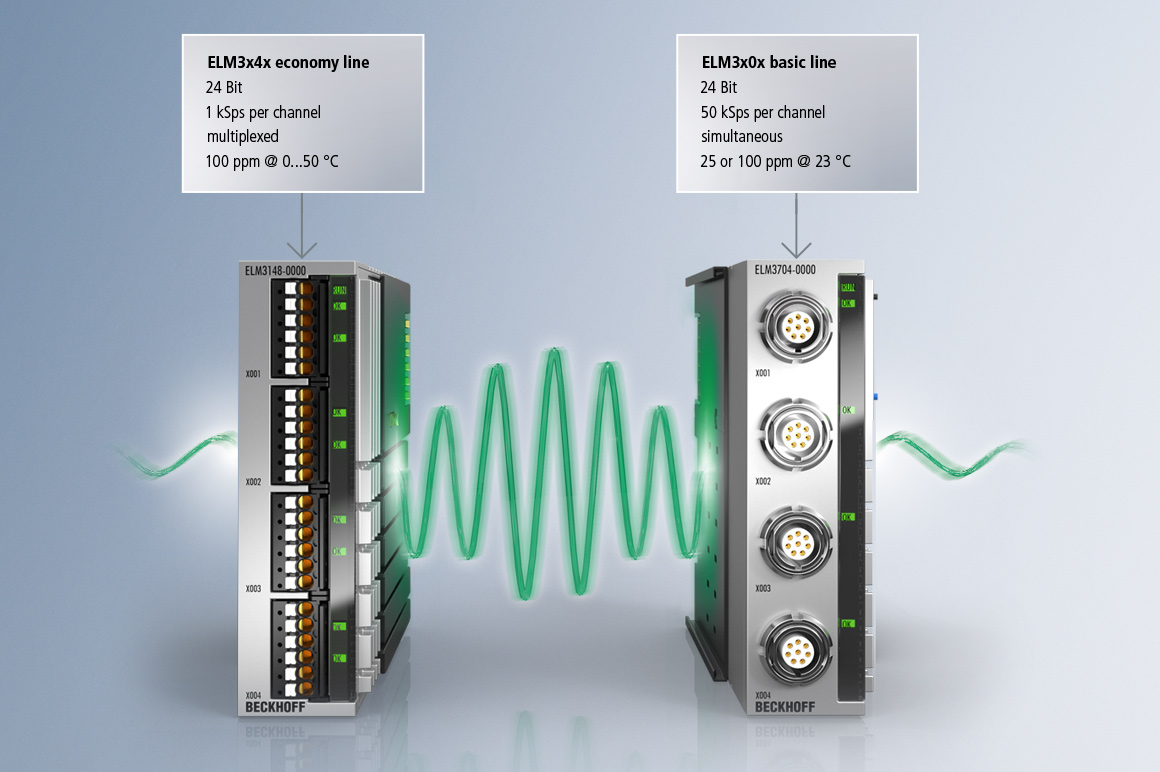
With its continually expanding measurement technology portfolio, Beckhoff serves the entire bandwidth of requirements in industrial measurement technology: from 1 Hz to the kHz range, from the measurement of current and voltage and from vibration to force measurement. IP20 components read in the sensors from inside the control cabinet. Seamlessly integrated into the EtherCAT I/O system, the high-end measurement modules from the ELM device series also record those process-critical measuring channels for which the standard analog technology in the EL/KL terminal system is not suitable.
The basic line measurement modules are conceived for the recording of highly dynamic events with high measuring accuracy – simultaneously on all channels and modules. The economy line is intended for the recording of less dynamic processes. An integrated 24 V sensor supply and 24 V power contacts reduce the wiring work in the control cabinet. With their enormous temperature stability of 100 ppm in the temperature range normally found in control cabinets, these modules even tower above the basic line.
Typical signal forms required for the measurement of prototypes or for condition monitoring, such as strain gauges, temperature sensors and accelerometers, are naturally also available. Both product lines support proven EtherCAT features such as distributed clocks time stamping in ns format and bus diagnostics. The modules are ideally supplied with power by system components such as the EKM1101 EtherCAT Coupler. Integrated diagnostics functions ensure reliable measurement.
Beckhoff measurement technology offers the right device class for every application:
- recording of operation and diagnostic data in the database or in the cloud
- reliable data analysis
- improved diagnostics
- increased system availability; longer lifetime
- lower maintenance and system costs

EL3632 EtherCAT Condition Monitoring Terminal
This terminal now represents a key component in thousands of condition monitoring applications for monitoring gear units, generators and bearings. For the standardized interfaces of the EL3632, the IEPE and ICP, a huge number of sensors are available on the market. These are recorded with up to 50 kHz with the help of oversampling technology.

TwinCAT integrates condition monitoring into the control system
A modular construction kit of mathematical algorithms for the analysis of measured values is available in the TwinCAT Conditioning Monitoring library. The library’s functions are primarily relevant to analysis, statistics and classification. In addition to spectral analysis via FFT or using, for instance, an envelope spectrum, it is possible to calculate key statistical values such as the kurtosis or the crest factor. Combining these algorithms with limit value monitoring is, for instance, ideally suited to monitoring roller bearings. However, it is recommended to analyze the status data in the condition monitoring software of a third party, which is directly integrated into the Beckhoff control platform as a licensed TcCom module under TwinCAT 3. Noted companies in the wind power industry have already implemented their solutions in TwinCAT. If component-related threshold values are exceeded, the CM system triggers alarms that inform the system operator about wear, imbalances or impermissible operating states. These alarms can be reported for further processing directly to the system controller or other operator systems. Of course, the continual machine monitoring can take place online. Trends in the characteristic values are analysed here and translated into recommendations for action, for example for the planning of maintenance intervals.