Flexible, dynamic labeling using servo technology in a terminal format
When developing its weLABEL labeler, packaging machine manufacturer Weber Food Technology faced the challenge of finding the most compact possible way of executing dynamic and precise motion sequences. It successfully achieved this with the help of compact drive technology from Beckhoff, which minimized the installation space, the load that needed to be moved, and the installation requirements.
In 1981, Weber Food Technology was founded in Breidenbach, Germany, and today employs over 2,100 people worldwide. It is a leading system provider for slicing applications in the food processing industry. As Michael Brandt, Managing Director Technology at Weber, explains: “We develop complete slicing and packaging lines that cover everything from weight-accurate slicing to precisely inserting and packaging sausage, meat, cheese, and vegan substitute products. We are dedicated to ensuring our systems meet high quality standards – something that is reflected in our consistent Made in Germany philosophy, for example, and our high vertical range of manufacture, which reaches over 80%.” Martin Grünkemeier, Group Manager for Labeling and Printing, adds: “A good example of the integrated, flexible nature of our solutions is the weLABEL labeler that we have added to our portfolio. It can be flexibly adapted to each customer’s requirements – not only does it offer a lot of versatility through the possibility of combining four labelers with a Weber thermoforming packaging machine, but it can also be used with packaging machines from third-party suppliers.”
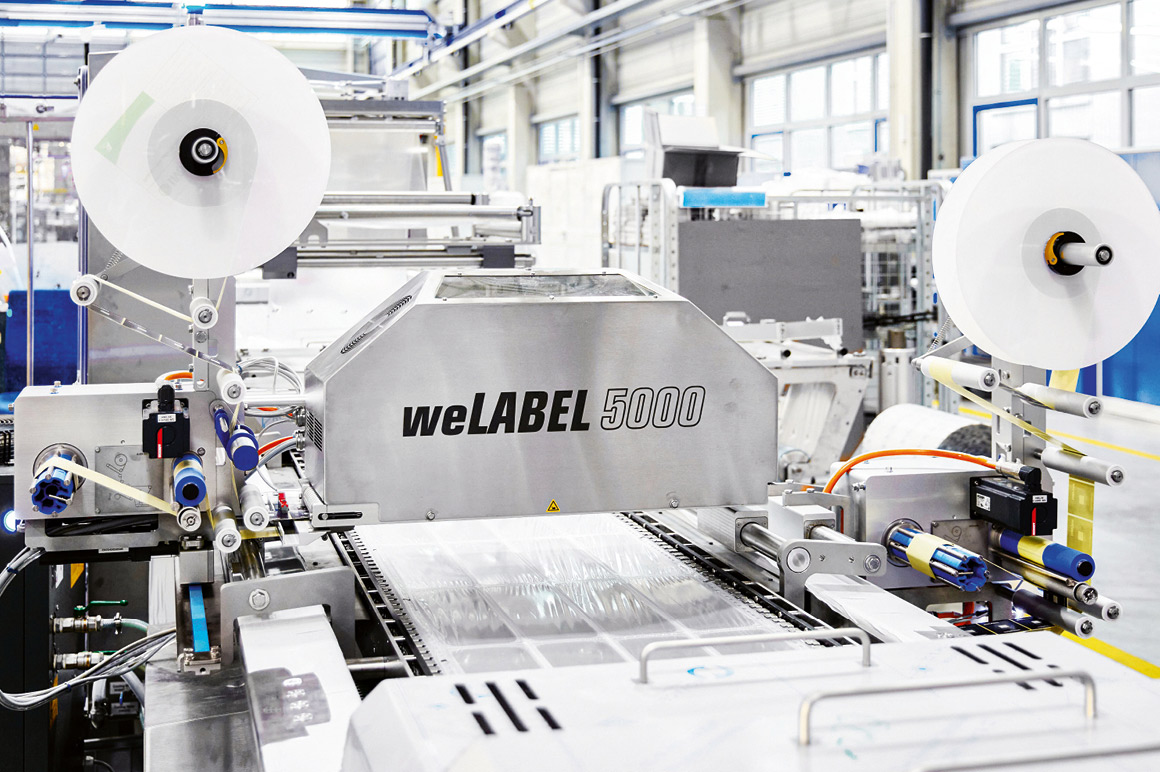
Flexible labeling tailored to specific applications
Each labeling process is based on the specific needs of the application. This may mean that one bottom-web and one top-web labeler are enough, or two of each can be used in a fully expanded version for optimized processes. Using four labelers avoids the kinds of machine downtimes caused by replacing an empty labeler roll, for example. The same goes for high-speed systems, as two weLABEL systems can share their labeling tasks – meaning that the roll can be changed without any downtime and at only a slightly reduced cycle rate.
A weLABEL labeler consists of a dispensing unit (with or without a printer), an applicator, and a longitudinal traversing unit. It provides four axes of movement, excellent positioning accuracy with flexible positioning, high acceleration of up to 60 m/s2, and – when combined with a thermoforming packaging machine – an output rate of up to 192 labels per minute. The associated process sequence starts by feeding in the label rolls using reel discs and then, if required, running them through a printer. A dispensing edge is then used to separate the labels from their backing material, and the labels are transferred from the dispensing unit to an applicator. The backing material is wound up and conveyor belts transport the individual labels on the bottom web carrier below the packaging and on the top web carrier above the packaging. The labels are then pressed onto the packaging using a lifting unit actuated by servomotors. Martin Grünkemeier adds: “A special feature of the weLABEL is the use of spring pins in the process of pressing on the labels, something that allows the system to accommodate different packaging shapes and sizes – especially since the spring pins can extend by as much as 35 mm. This means that there are no issues with labeling uneven surfaces or sloping packaging bases, and the necessary contact pressure is applied at every point.”
Compact drive technology saves space and lightens the load
Michael Brandt believes that the modular, highly compact weLABEL design is crucial: “Each labeler has a small control box for the control technology it needs. The compact 48 V drive technology from Beckhoff, with ELM7222 or ELM7231 servomotor EtherCAT Terminals and AM8100 servomotors, is ideal for saving installation space and keeping the load to be moved as small as possible. This combination also has a great price-performance ratio and delivers full-scope servo performance, which is essential for the high levels of accuracy we need.” In addition, he says, this highly demanding application can be controlled with four labelers and, therefore, 16 axes, using the C6015 ultra-compact Industrial PC, which measures just 82 x 82 x 40 mm and is equipped with sufficient interfaces. If demands become even greater in the future, it will be possible to benefit from the extensive, finely scalable Beckhoff IPC portfolio.
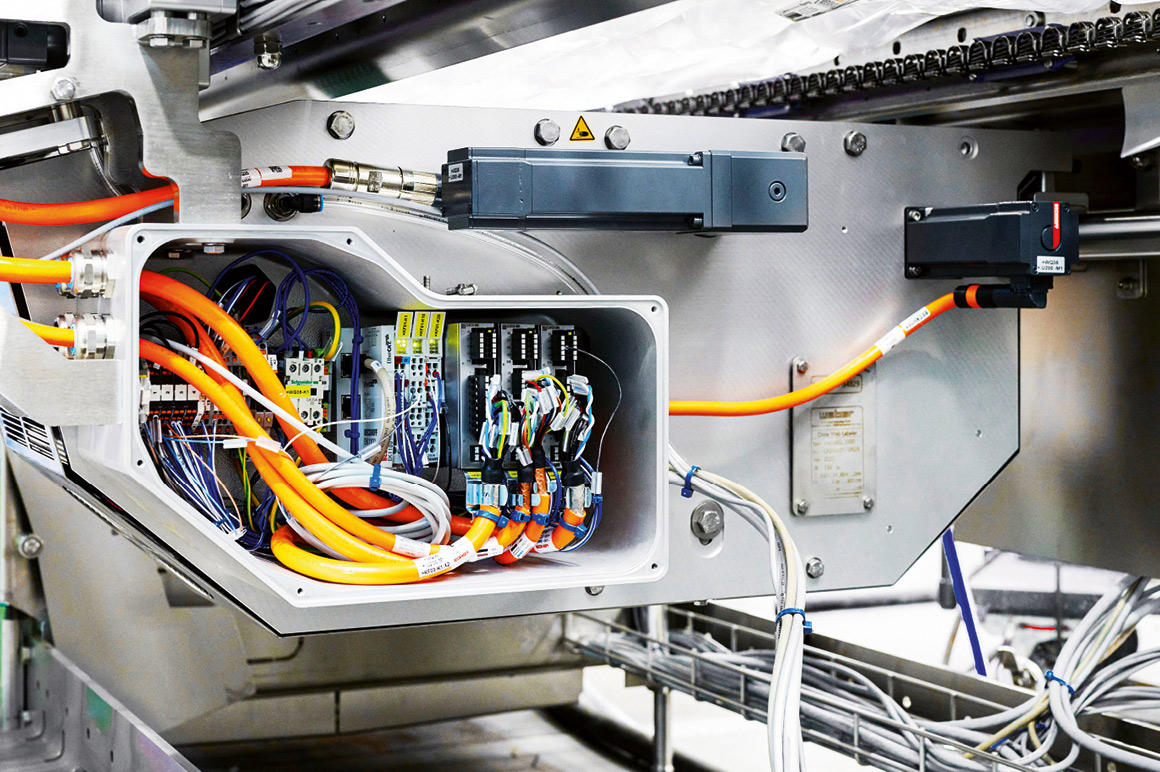
The compact design with minimal load makes it possible to move the labeler much more dynamically than a version with conventional drive technology. The maximum permissible speed is also higher as a result of the reduced kinetic energy. For Martin Grünkemeier, there are three other essential features: firstly, the small control box that moves with the vehicle, avoiding long wiring and complex drag chains. Secondly, Beckhoff One Cable Technology (OCT) is a useful addition in that it reduces installation space, minimizes installation work, and prevents sources of error as there are fewer connectors and associated openings in the control box. Thirdly, there is the outstanding 48 V servo technology – which incorporates not only integrated TwinSAFE Safe Motion, but also the servo properties themselves, which prevent the need for reference runs after label rolls have been changed, for example.
Dirk Bauerfeind, Beckhoff Global Key Account Management, points out another advantage: “With compact drive technology, the 48 V supply also acts as a DC link via which energy can be transferred between the axes. This significantly minimizes the need for energy output through the braking resistor.” Martin Grünkemeier also confirms this: “In this labeling application, many movements take place in parallel, which means that energy is simultaneously consumed during acceleration and released during braking, and can be used regeneratively. Without this function in the 48 V supply, a significantly larger DC link capacity would be required or we would end up with heat losses of the same magnitude through the braking resistors.” Michael Brandt adds: “We also benefit from the special epoxy resin coating on the AM8100 servomotors and the corresponding motor/gearbox combinations, as the labelers are also used in areas with strict hygiene requirements and therefore need to be able to withstand cleaning processes.”
Flexible control software and hardware
The software and hardware in Beckhoff control and drive technology feature flexibility, modularity, and universality. As a holistic software platform, TwinCAT 3 offers a wide range of functions for efficient labeling processes – from motion control and the event logger for diagnostics to communication interfaces such as the JSON Data Interface. Added to this, Martin Grünkemeier says, is the system-integrated safety technology: “Direct safety integration allows for a more flexible machine safety concept as well as separate smaller safety projects. These are implemented with TwinSAFE and the ELM terminals Safe Limited Position (SLP) and Safe Limited Speed (SLS). Used in conjunction with a safety laser, this makes it possible to implement area detection, which ensures the labeler reduces its travel speed when someone enters zone 1 and stops when someone enters zone 2. What makes this feature really special, and something unique to the market, is that the system continues to run immediately after the safety zone is exited.”
EtherCAT also offers the outstanding flexibility that is required, according to Martin Grünkemeier. He adds that the free approach to topologies allows for a mixture of star and ring topologies, and the wide range of EtherCAT I/Os is useful for implementing the labeling functions that are required. A good example he mentions is the EL2258 8-channel digital output terminal, which serves as a cam switch for outputting printer start signals.
Further information


