
All devices in a smart grid, whether energy generators, consumers, or storage systems, must be able to communicate with one another. Standardized communication protocols exist for this purpose. The IEC 61850 standard describes communication protocols for protection and control equipment in electrical substations. The communication services and basic data model are designed for more than just general station automation. This is achieved through industry-specific data models. There are specific supplements available for wind turbines, hydropower plants, and other decentralized energy generation systems, including photovoltaic systems and fuel cells.
The TF6510 TwinCAT 3 Function precisely maps this communication and its data models. The communication stack required for this is developed entirely within the PLC. The IEC 61850 services are mapped to the MMS communication protocol (Manufacturing Message Specification). Client and server can be implemented.
The data model is configured using the TwinCAT Telecontrol Configurator. It provides all the necessary information about the different industry-specific data models. The configurator takes into account many of the dependencies defined in the standard. This helps avoid incorrect configurations. It is possible to load and save the standard’s description files (ICD files) or to build a data model from scratch using a wizard to support the creation process. After completing a configuration that includes all datasets and reports, it can be automatically converted into readable PLC code using the Deploy Wizard. A few basic services are coded as examples. The generated code is available immediately for an initial communication test. This significantly cuts down on the time needed for application development.
The same workflow applies to the GOOSE communication channel. This real-time network protocol is used primarily for communicating status changes in electrical substations. Like client and server via MMS, publisher and subscriber for GOOSE are part of TF6510.
In addition, TF6510 also supports IEC 61850 Sampled Values, thereby expanding the communication capabilities to include the transmission of current and voltage values in time-critical applications.
Product status:
regular delivery
Product information
| Technical data | TF6510 |
|---|---|
| Required license | TC1200 |
| Includes | TF6310 |
| Operating system | Windows 10, Windows 11, Windows CE, TwinCAT/BSD, Beckhoff RT Linux® |
| CPU architecture | x86, x64, Arm® |
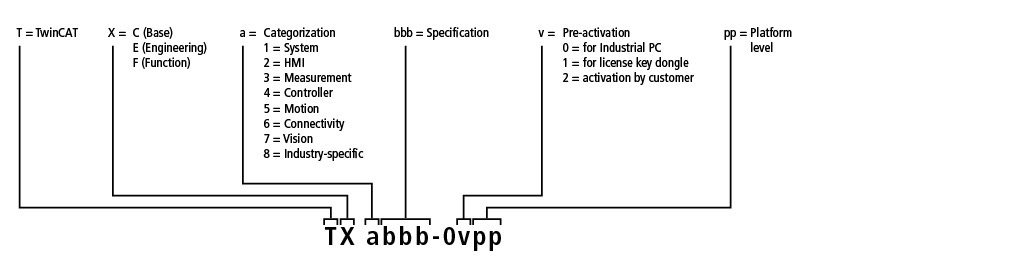
| Ordering information | |
|---|---|
| TF6510-0v20 | TwinCAT 3 IEC 61850/IEC 61400-25, platform level 20 (Economy) |
| TF6510-0v30 | TwinCAT 3 IEC 61850/IEC 61400-25, platform level 30 (Economy Plus) |
| TF6510-0v40 | TwinCAT 3 IEC 61850/IEC 61400-25, platform level 40 (Performance) |
| TF6510-0v50 | TwinCAT 3 IEC 61850/IEC 61400-25, platform level 50 (Performance Plus) |
| TF6510-0v60 | TwinCAT 3 IEC 61850/IEC 61400-25, platform level 60 (Mid Performance) |
| TF6510-0v70 | TwinCAT 3 IEC 61850/IEC 61400-25, platform level 70 (High Performance) |
| TF6510-0v80 | TwinCAT 3 IEC 61850/IEC 61400-25, platform level 80 (Very High Performance) |
| TF6510-0v81 | TwinCAT 3 IEC 61850/IEC 61400-25, platform level 81 (Very High Performance) |
| TF6510-0v82 | TwinCAT 3 IEC 61850/IEC 61400-25, platform level 82 (Very High Performance) |
| TF6510-0v83 | TwinCAT 3 IEC 61850/IEC 61400-25, platform level 83 (Very High Performance) |
| TF6510-0v84 | TwinCAT 3 IEC 61850/IEC 61400-25, platform level 84 (Very High Performance) |
| TF6510-0v90 | TwinCAT 3 IEC 61850/IEC 61400-25, platform level 90 (Other 1…4 Cores) |
| TF6510-0v91 | TwinCAT 3 IEC 61850/IEC 61400-25, platform level 91 (Other 5…8 Cores) |
| TF6510-0v92 | TwinCAT 3 IEC 61850/IEC 61400-25, platform level 92 (Other 9…16 Cores) |
| TF6510-0v93 | TwinCAT 3 IEC 61850/IEC 61400-25, platform level 93 (Other 17…32 Cores) |
| TF6510-0v94 | TwinCAT 3 IEC 61850/IEC 61400-25, platform level 94 (Other 33…64 Cores) |
We recommend using a TwinCAT 3 license dongle for platform levels 90-94.
Loading content ...
Loading content ...
Loading content ...
© Beckhoff Automation 2026 - Terms of Use