A comprehensive automation and safety architecture is essential for systems for decentralized energy supply and storage that use battery and hydrogen technology. In the H2PowerCube container solution, Beckhoff’s PC-based control technology serves as the digital backbone, connecting the fuel cell with electrolyzers and battery storage systems to form a flexible overall system. The consistent modular design of both hardware and software enables clearly defined system boundaries and economically efficient operation in a variety of energy environments.

The massive expansion of volatile, renewable energy sources such as wind and solar power poses challenges for grid operators and the manufacturing industry. To ensure power grid stability while also guaranteeing a self-sufficient, decentralized energy supply, storage systems with a capacity of up to five megawatts are becoming a key focus for the industry. This is where H2 Powercell comes in with its container-based H2PowerCube. It integrates electrolyzers for the production of green hydrogen, a fuel cell for reconverting it into electricity, and battery storage for the efficient delivery of electrical and thermal energy.
The target applications cover a wide range of use cases: from hydrogen refueling stations and microgrids to complex sector-coupling projects, including the opportunity to use hydrogen as a material. “We offer our customers both future-proof hydrogen technology and ready-to-use solutions that are precisely tailored to the needs of the market,” emphasizes Sebastian Niehoff, Managing Director. “This allows users to not only participate in the energy market, but also help stabilize the grids decentrally – which is a highly topical issue given the current discussion on infrastructure resilience.”
Thermodynamic complexity and high data density
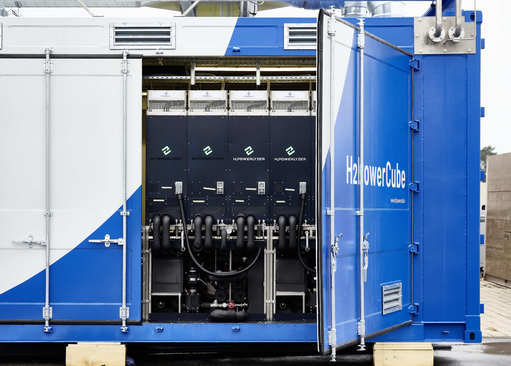
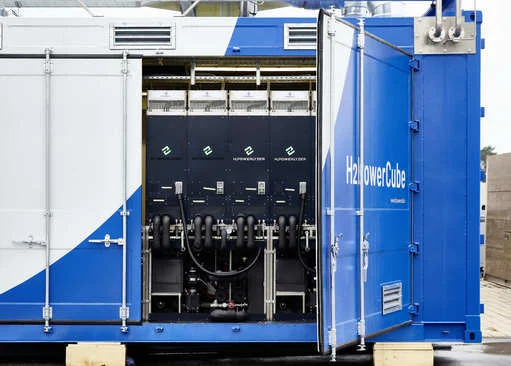
Operating this type of system safely and efficiently within the footprint of a container requires a paradigm shift in plant automation. Previous hydrogen plants were often implemented as monolithic, rigidly programmed large-scale projects that were very difficult to adapt later on. H2 Powercell, in contrast, applies the principles of modular machine building to process engineering. The core component of hydrogen production is the H2PowerLyzer modular electrolyzer system. Up to 24 of these systems can be cascaded in a single container to achieve a capacity of up to 1.2 MW. However, this high level of modularity presents challenges in terms of automation technology. The H2PowerCube control system has to process an immense volume of data in hard real time, synchronize complex thermodynamic processes, and meet very stringent functional safety requirements. What’s more, integration into the relevant environment requires a flexible communication connection. Since the container power plant is designed to operate completely autonomously and does not require an external higher-level control system, all control logic must be fully integrated within the plant itself.
PC-based control as the central brain
Beckhoff’s PC-based control system is used to solve this multidimensional task. All energy and information flows converge in a C6015 ultra-compact Industrial PC that forms the container’s topological center. Equipped with a quad-core processor, the industrial PC provides sufficient computing power to synchronize the electrolysis and power generation processes with zero latency. “The performance of the control technology plays a key role,” explains Jens Fröhlich, who is responsible for automation and system integration at H2 Powercell. “The monitoring of electrolyzers is a good example. The voltage in each individual cell is sampled at millisecond intervals to immediately detect degradation effects or anomalies. When 24 H2PowerLyzer modules are installed in the container at the maximum capacity, the voltage sensors alone generate an enormous amount of data. We therefore consciously chose a very high-performance industrial PC.”
Decentralized signal acquisition within the overall system is handled by Beckhoff’s extensive range of EtherCAT Terminals. In their standard configuration, the electrolyzer modules do not have their own control system; instead, they are seamlessly connected to the C6015 via EK1100 EtherCAT Couplers. EtherCAT Terminals from the EL series integrate all sensors required for temperature, pressure, and flow measurements. “Beckhoff’s extensive I/O portfolio alone makes it the ideal partner for us. There’s virtually no bus protocol that the EtherCAT Terminal range doesn’t support,” Jens Fröhlich continues. “This allows us to provide all the necessary physical interfaces on the couplers. As a result, we can significantly reduce the amount of cable we use and the amount of work required to wire the container.”

Safety without conventional Ex zones
A standout feature of the H2PowerCube is its innovative safety concept. In hydrogen production plants, designating extensive explosion protection zones is typically the norm, requiring pressure-resistant enclosures and cost-intensive special hardware. H2 Powercell resolves this conflict through smart, active monitoring that is deeply integrated into the automation architecture. A redundant ventilation system, combined with sensitive gas detection sensors, ensures that a hazardous explosive atmosphere cannot form inside the container in the first place. This preventive safety concept is fully controlled and monitored using TwinSAFE. Signals from the gas sensors, pressure switches, and fan drives are fed directly into the central controller via safe I/O terminals and the Safety over EtherCAT (FSoE) protocol. “In the hydrogen sector, safety is the top priority,” emphasizes Manfred Limbrunner, Business Development, Sales & Marketing at H2 Powercell. “With safety already integrated, we can easily add on the features we need. If the relevant standards and guidelines are modified in the future, we can make adjustments without having to redesign the physical control architecture.”
In terms of software, the TwinCAT automation suite manages operations, including complex thermodynamic control. The system is designed as a highly efficient single-circuit system. The process water from the electrolysis also serves as cooling water, which requires precision-controlled hydraulics. This architecture is highly sustainable, as the waste heat generated by the process can be directly harnessed via the heat control loop and distributed as district heating. To manage this complexity in an engineering context, users leverage the object-oriented programming capabilities in accordance with IEC 61131-3, which TwinCAT offers natively. “Once we’ve created and validated software modules – for electrolyzers, as an example – all we need to do is duplicate them when we’re scaling the overall system later on. That’s a key feature,” explains Jens Fröhlich. “This ensures that the solution remains completely modular and clearly organized from a software perspective as well.”
One system, five interfaces
The manufacturer consistently cuts down on system limitations, minimizing the work required to integrate the product into the environment in question. Externally, the container has only five interfaces: hydrogen, electrical power, district heating, waste water/exhaust air, and a combined interface for control and remote access. Via the industrial PC, the H2PowerCube communicates with all relevant peripheral systems in the environment concerned – whether they be charging stations, photovoltaic inverters, external batteries, or grid control centers. Protocols such as OPC UA and Modbus TCP are used for this purpose. In addition, TwinCAT 3 Power Control – a certified EZA controller – will be integrated in the future to connect energy generation systems to medium and high-voltage grids in compliance with connection guidelines. A customer-specific CP3918 multi-touch Control Panel is installed in the container for local operation and visualization. High-resolution recordings of the process data are captured in parallel using the TwinCAT Scope View software oscilloscope and visualized in TwinCAT HMI.
AI-based condition analysis
With Beckhoff's automation technology, H2 Powercell not only ensures compliance with current technological standards, but also aims to pave the way for future innovations and drive decentralization forward. Customers who purchase H2PowerLyzer electrolyzers as standalone modules will, in the future, receive them with an integrated embedded PC instead of the bus coupler. This scalability via TwinCAT ensures that hardware topologies can change without the need to redevelop the software foundation.

There are also plans to implement artificial intelligence. The data that is continuously recorded with TwinCAT Scope can be used, for example, to draw valuable conclusions on the degradation of the membranes and the remaining service life of the electrolyzers. Until now, process engineers have performed this evaluation manually. To automate this process in the future, Beckhoff provides the necessary foundation: “TwinCAT Machine Learning Creator offers a versatile tool for AI-based analysis of this type of monitoring. In the future, AI models based on time series will enable real-time anomaly detection,” says Robin Bertling, who works in Sales at Beckhoff, outlining the next step in development.
The H2PowerCube demonstrates that the energy transition is both feasible and economically scalable through modern automation, and that it also ensures a resilient energy supply. “The turnkey combination of electrolysis, fuel cells, and batteries provides an ideal foundation for flexible energy management. When there is a surplus, the energy is stored or converted into hydrogen. When energy is needed, it’s generated right on site,” says Sebastian Niehoff, summarizing the advantages of the modular container power plant. Beckhoff’s PC-based control technology not only provides the necessary computing power and openness, but also enables a resilient and sustainable energy infrastructure.
-
09.07.2026
Up to 24 modular H2PowerLyzer units can be cascaded in an H2 Powercell container power plant.
Industries

Chris Bladek
Beckhoff Automation Ltd.
4 Schiedel Court, Unit 1-3
Cambridge ON N3C 0H1
Canada