Fast communication via EtherCAT and EtherCAT P in a nickel cutting line
SafanDarley has been building sheet metal processing machines for many decades, up to now relying on traditional PLC systems. However, the machine builders were curious about the PC-based control technology from Beckhoff. A pilot project with a nickel cutting line had them convinced: reusable software objects for motion control, extensive expansion options, and significantly simplified wiring through One Cable Automation with EtherCAT P.
SafanDarley, formed from the merger of Safan and Darley, has a history of over ninety years in machine building for sheet metal processing. Just as traditional as the machine building itself is the control technology. The company uses conventional PLC, says Chris Utens, senior software engineer at the Eijsden location, where the focus is on heavier hydraulic machines and special projects. “We didn’t have any experience with Beckhoff, but we were curious about PC-based control technology from the creator of the EtherCAT protocol. The fast, Ethernet-based communication allows for easy connection to various machine types, and since our machine control requires a lot of decentralized I/Os, this was very interesting for us.”
Developed from scratch
After a visit to the Beckhoff stand at Hannover Messe 2024, Chris Utens and his colleague, software engineer Jelle Adema,became enthusiastic about their products and working methods presented. So, they decided to approach the implementation of an automated nickel cutting line for a customer in South Africa as a pilot project with Beckhoff. “We attended training sessions and got started, engineering the control from scratch; selecting hardware and programming software for PLC, safety, and HMI with TwinCAT.”
The line layout was shaped like a square, which is why SafanDarley opted for a star topology of the control network. Connections run from a central cabinet to decentralized electrical cabinets and EtherCAT P box modules on the various components of the line. All remote I/Os for axes, grippers, sensors, and so on are controlled from such an I/O island. EtherCAT P combines communication and power in a single 4-wire Ethernet cable – based on the One Cable Automation from Beckhoff. Chris Utens: “Only one cable is needed; that was an eye-opener for us. EtherCAT P is a bit more expensive, but making the connections is very simple, which means there’s little risk of errors and the machine can be set up quickly. We even had interns do part of the wiring.”
Cutting with care
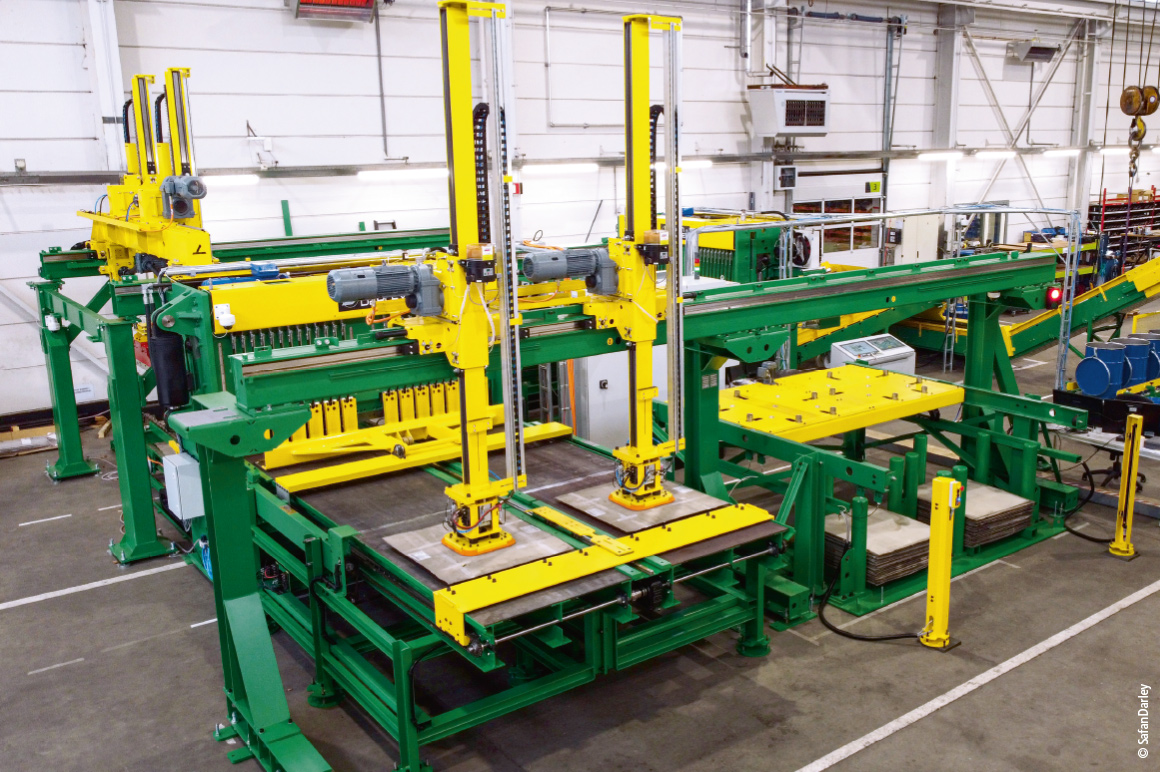
The line begins with the infeed of so-called cathodes, nickel plates measuring 900 mm x 900 mm. They are picked up with a pneumatic gripper, centered on a measuring table, precisely measured for length, width, and thickness, weighed, and then transported to the infeed table of a hydraulic shear. This shear is adjusted to ensure each cathode is cut correctly, in terms of cutting length, gap, angle, and force. Jelle Adema explains: “The cathodes are never perfectly homogeneous, with curves, bumps, and ears.”
The cut strips are collected and presented to a second shear, which cuts them into small blocks of 100 x 100 mm. The cut blocks are weighed before being filled into drums. The product is then ready for sale, says Chris Utens. “The nickel is used, for example, in the manufacture of car batteries or in the melting process for the production of certain metal alloys.”
Object-oriented programming
The line had to be able to process two tons of nickel per hour and be operated by a single operator. That’s where the controls from Beckhoff came into play, explains Chris Utens: “We developed an object-oriented framework, based on the PackML standard, for programming the control in Beckhoff’s TwinCAT environment. For each EtherCAT network participant, such as shear, pick and place, and measuring table, we defined a software module as an object.” Subsequently, network configuration is quick and easy. When a PLC is switched on, it automatically reads in all connected EtherCAT P box modules. “You no longer have to manually set up and configure the entire network.”
Gradually, the software engineers discovered the potential. Jelle Adema: “For example, the customer requested a specific type of drives. With our standard PLCs, connecting them to the controls was a real hassle, but now it was very easy. Writing settings to IO-Link modules and connecting EtherCAT P modules is very simple; there are many expansion modules, and extensive diagnostic options.”
Operation with only one operator
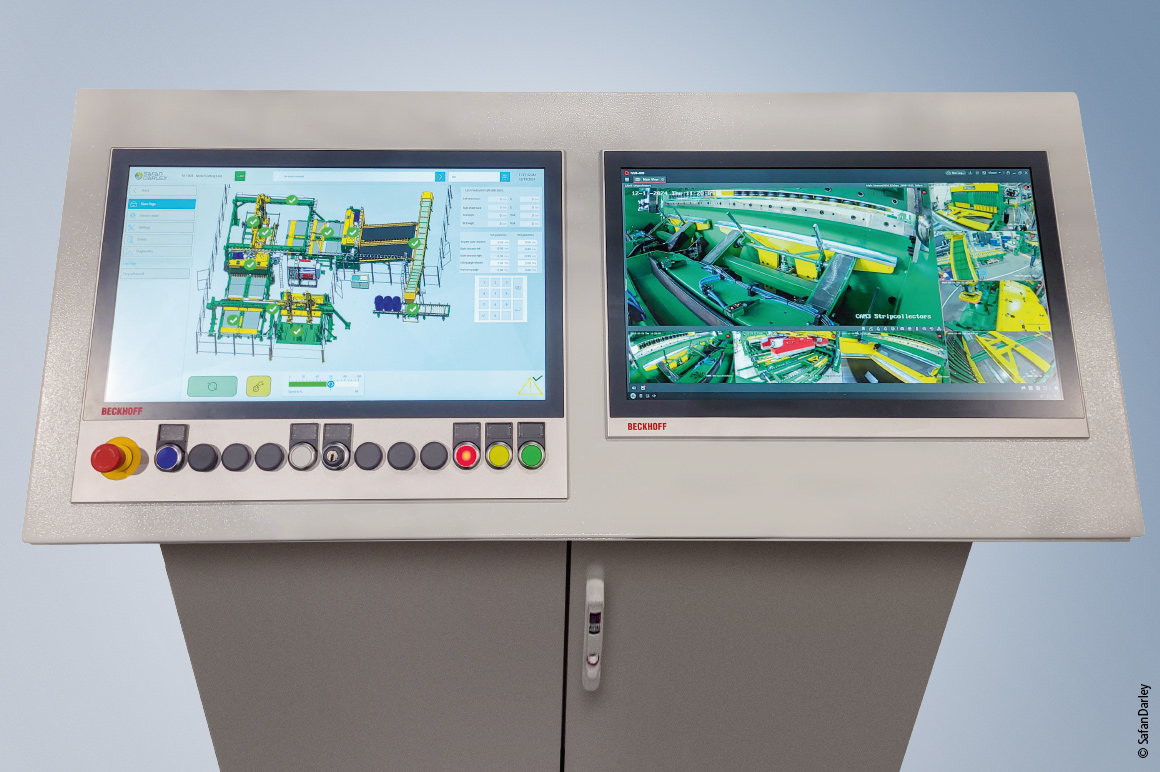
Another interesting feature is that the control panels from Beckhoff can be customized, including with push-button extensions, and emergency stop elements. The control console of the nickel cutting line contains a panel with the operating interface along with another one showing live camera feeds from the line. A total of eight cameras have been installed to monitor critical points, such as the shears, the pick-and-place units, the infeed, the filling station and the measuring table. The HMIs can be positioned freely; distances of up to 50 m from the central cabinet, with a Beckhoff CX-series Embedded PC, are no problem.
The operating interface is web-based, making it easy to transfer to a tablet. This allows the operator to walk around the line, for example, to troubleshoot malfunctions while the control is in manual mode. A distributed safety function is available for this purpose. If the main line is at a standstill in service mode, a partial safety module can be allocated to the remote I/O box of, for example, a shear that requires manual control. A hold-to-run switch then allows safe operation and maintenance.
New control standard?
The project progressed smoothly. This was partly due to the standard software blocks that proved very useful, and also to the custom-created objects that were easily reusable, according to Chris Utens. “We started in week 20 of 2024 and were able to deliver the complete line in week 50. It was an ambitious project – with 300 remote I/O units, 15 servo axes, and two heavy-duty hydraulic axes for the shears – and we were able to complete it on schedule.”
Will SafanDarley switch to Beckhoff completely based on the positive experiences? That discussion is currently underway, says Chris Utens. Beckhoff recommends starting with just one aspect, such as PLC, safety or motion, according to Chris Utens. “We’ve started a new project for a press brake with an automatic tool change station. The press brake runs on our standard PLC, but we’ll be controlling the rest of the automation with Beckhoff. That will be the new standard for our special projects.”
Further information


