New installations at the Vienna State Opera
The Vienna State Opera is one of the world’s leading opera houses, supported not least by its continuously evolving event technology. Following a successful collaboration with the Vienna-based specialist Salzgeber and Beckhoff Austria to renew the sound and video control room, another project has now been completed. This was based on end-to-end system communication using EtherCAT and TwinCAT 3 TCP/IP, enabling the seamless integration of systems such as those from Riedel Communications.
Each season, the Vienna State Opera presents more than 60 different opera and ballet works in around 350 performances – an immense program that must not be disrupted, even by extensive modernization measures. Athanasios Rovakis, Head of Audio & Video Technology, explains: “There was only a small window of opportunity to replace the 20-year-old technology. So it was a very demanding undertaking, especially since errors during live performances are simply not an option. Even the first dress rehearsal before the opening performance had to run flawlessly. This meant that the integration period was only six weeks, including hardware processing as well as the complete programming and commissioning of all audio DSP call circuits and the lighting and video switching. The time available for commissioning and testing was less than two weeks.” Tino Pfeifer, Senior Project Engineer at Salzgeber IT-Revolutions, adds: “The aim was to use new functions to make it easier for the stage manager to coordinate the almost 200 people involved in a show. In addition, the existing components – such as pushbuttons and signal lamps for switching video and audio sources, as well as for displaying director‑controlled scenes – had to be integrated seamlessly.”
Diverse communication requirements
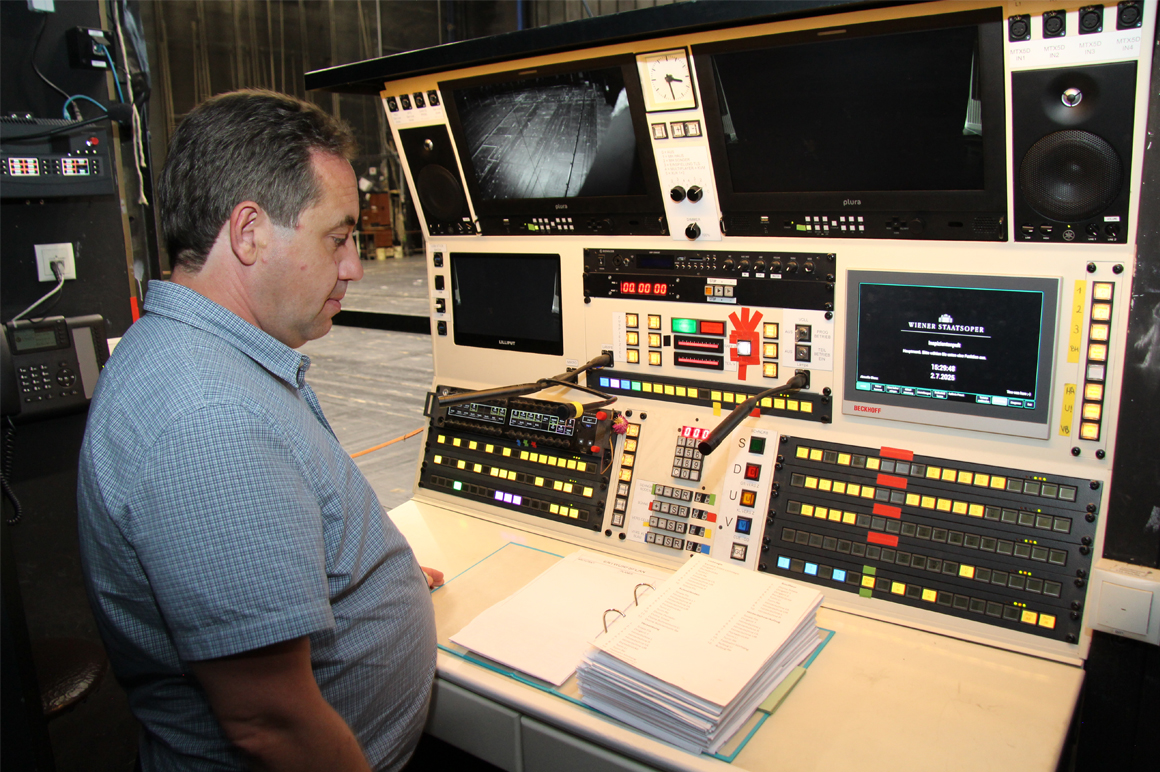
The stage manager’s desk is the central point from which all actions on stage and all technical processes are managed. A wide range of communication methods are used here: from audible announcements and light signals as color codes to number indications for the scenes to be called. This requires both 1:1 point connections and 1:n connections as well as bidirectional wireless communication – in other words, classic intercom functions. This is supplemented by the management of around 30 cameras, which allow, for example, singers waiting for their entrance to be observed from various perspectives or the movements of stage lifts and scenery to be monitored.
Implementing all of this in a sufficiently dynamic and flexible way to meet the varying requirements from one production to the next – while also integrating the previously renewed sound system seamlessly – offers many advantages. Tino Pfeifer explains: “Linking the stage management systems makes it possible for everything to run synchronously on a central controller – in this case, a C6030 ultra‑compact Industrial PC from Beckhoff. The prerequisite is that all integrated devices can be fully controlled. The remote I/Os, pushbuttons, light signals, and serial interfaces are EtherCAT‑capable, ensuring very fast data transmission and comprehensive network diagnostics. Rather than implementing classic product combinations with certain predefined functions, we are using the C6030 as a central core that enables any logic or communication between all network participants. This results in an agile system that will allow future ideas and customizations to be implemented in a highly flexible manner.”
The Beckhoff TwinCAT software also offers a high degree of flexibility; for example, via the TwinCAT 3 TCP/IP function (TF6310), which is used to implement one or more TCP/IP servers and/or TCP/IP clients in the TwinCAT 3 PLC. This made it possible, for example, to implement the established Telnet network protocol as well as string transmission via TCP/IP. In total, there are around 25 network participants – i.e., TCP/IP connections – that must be maintained simultaneously in order to communicate with all buttons, video controllers, audio DSPs, etc. The communication systems from Riedel Communications, Wuppertal, can also be integrated via TwinCAT 3 TCP/IP. For this purpose, the essential parts of the RRCS protocol from Riedel are supported in TwinCAT on the basis of TwinCAT 3 TCP/IP, enabling communication with Riedel’s Artist and Bolero systems as well as the use of Riedel SmartPanels. The combination of the Riedel system and TwinCAT 3 is what sets it apart from conventional stage management systems.
User-oriented operating philosophy
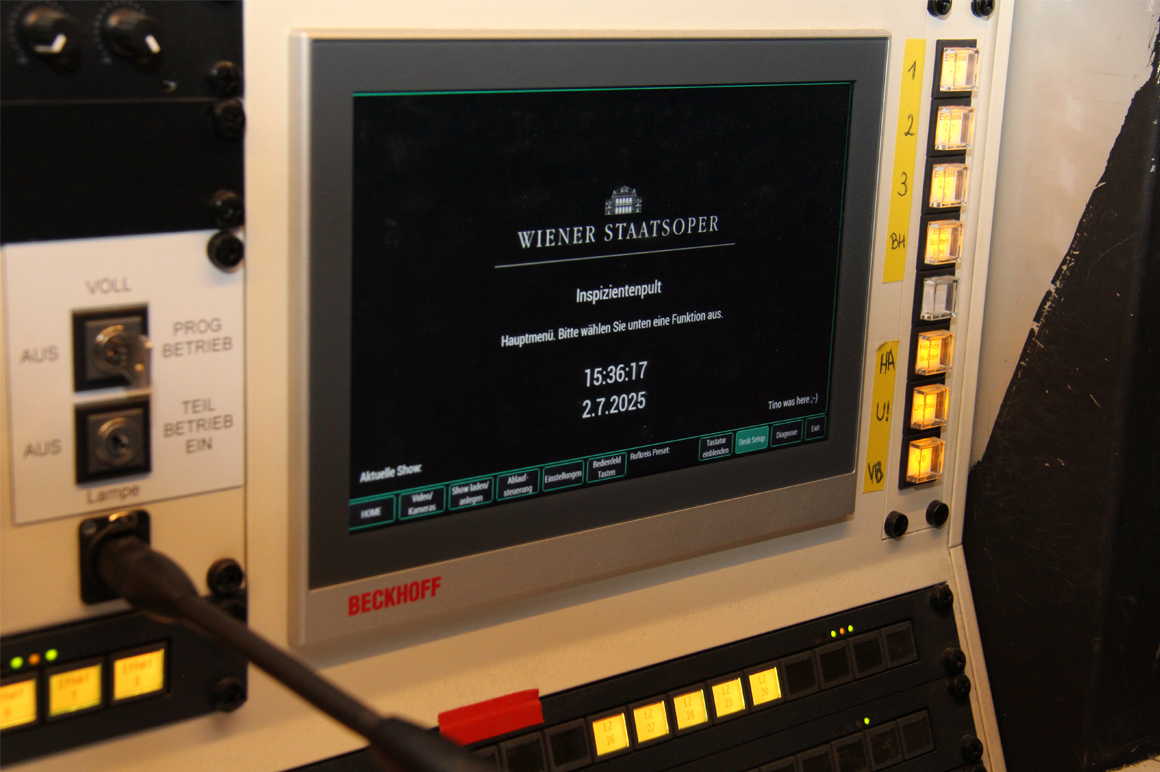
The stage manager’s desk contains numerous intuitive controls, including a CP29xx multi-touch built-in Control Panel from Beckhoff with TwinCAT 3 HMI as a modern and convenient user interface. According to Athanasios Rovakis, it is precisely this connection between seemingly old technology – with buttons and rotary potentiometers – and modern touch screen technology that results in optimum operability: “A purely touch-based interface is not feasible, not least because you can’t locate individual touch fields by feel when you also need to keep an eye on camera feeds or follow the score. Reactions are often required within milliseconds, and in some cases you even have to hit several buttons intuitively and correctly at the same time. The right haptic feedback is also very important, which is why selecting the hardware buttons required an extensive search process. The actuation point and response speed are crucial here.”
Added to this is the cross‑disciplinary communication approach: the stage manager’s desk brings together all departments – from mechanically movable stage elements to the lighting technicians, wardrobe staff, and performers, all the way through to sound and video. This is also reflected in the visualization implemented with TwinCAT HMI on the control panel, as Tino Pfeifer explains: “The visualization offers all the functions required for stage operation and device communication. Nothing was implemented in a static way, so everything remains dynamic and parameterizable, and can be easily configured via TwinCAT HMI. Each button on the desk has an ID and a defined function. Behind this is a PLC structure that can be copied at any time within these button fields – for example, to bypass defective buttons or to create an entirely new show configuration.” Athanasios Rovakis adds: “This has enabled several functions that are not available as standard. Examples include a technical assistant for an overview of light signals, as well as the ability to display user‑specific views – including on tablets or mobile devices via a web browser.”
Tino Pfeifer sees specific advantages for engineering in the TwinCAT 3 event logger and the EtherCAT diagnostics integrated into TwinCAT. With the event logger, any initial operating errors can be tracked quickly and easily – on a day with rehearsals and a performance, the log file can contain up to 10,000 events. EtherCAT diagnostics can be used to quickly locate open connections, for example. However, with the exception of defective network cables, there have been no failures in this project so far. “The entire system can be expanded to accommodate any future ideas and user requirements,” adds Athanasios Rovakis.


