Entering uncharted automation territory in the furniture industry
Kitchen production is undoubtedly an ultimate test of skill for automation. A lot size of one has been standard in the industry for many years. Yet the systems and methods used are continually being put to the test – for example, when the furniture range grows but the space in production does not. Or when an ageing part of the system increasingly becomes a bottleneck. So it’s good that the Beckhoff portfolio includes integrated drive solutions that enable innovative automation concepts – as the following project by custom machine builder Hüttenhölscher for kitchen manufacturer nobilia demonstrates.
nobilia-Werke J. Stickling GmbH & Co KG is one of the major kitchen manufacturers. The company can cover around 30% of Europe’s demand. In concrete figures, this means that up to 3,800 kitchens are produced and delivered every day – based on orders and customized accordingly. To handle this huge volume effectively, nobilia focuses on two aspects: The first is a production control strategy that starts at the end of the process and works backward. The entire logistics process is geared toward the question: “How can the truck be filled so that it can deliver the kitchens produced using the most efficient route possible?” Then, the second aspect also comes into play: a very high degree of automation. “How can we turn all the basic materials, such as the bodies, fronts, screws, or fittings, into customized pieces of furniture and move them – along with the ordered merchandise – to the right truck in one go? This only works with an unconditional just-in-time approach,” explains David Müller, Senior Project Manager at nobilia.
With around 19 cabinets produced every minute, nobilia’s Plant 2 alone has up to 100 fully loaded trucks leaving the yard every day. “You can imagine what happens if not every front is in the right place at the right time,” says Müller. Despite the huge dimensions – the plant is almost 700 m long and over 300 m wide – space in the production area is extremely scarce. Extending existing systems to adapt them to new requirements is simply not possible. Modernized machines must therefore not exceed the previous footprint.
This requirement also applied when nobilia needed to upgrade its drawer production system to a new technical standard. The background to this is that, in addition to its kitchen range, the company is now also addressing the growing demand for holistic furnishing solutions by offering furniture for other areas. So while the previous system was still dedicated to kitchens, more flexibility was now required to cover the significantly higher degree of variance. “We wanted to take the next step in terms of production technology and modernize our systems so that cabinet furniture for the living area or bathroom could also be produced,” emphasizes Senior Project Manager Müller.
Simultaneous start of production in two plants
Even if the previous drawer production system only took up a fraction of the production area in Plant 2, there was no more space available for the new system. Higher throughput, a greater level of automated variance, and increased safety were required. This posed a real challenge. In addition, another major challenge was the fact that the work did not just involve one system, but two identical lines for drawer production in two nobilia plants. The changeover to the new range, i.e., the start of production of the new systems, had to take place across locations. “This is one of the most sophisticated projects we have ever implemented at nobilia,” states Müller.
With these challenges in mind, nobilia brought two partners on board: Beckhoff as the supplier of the automation technology and Hüttenhölscher Maschinenbau GmbH & Co. KG, which has a very long history in the furniture industry and possesses the required expertise. Due to their geographical proximity – all three companies are based in Verl in East Westphalia – they have been working together for decades. “Together, we have already broken new ground in automation multiple times,” says David Müller, looking back. The aim was to continue this success story with the new drawer system. “So it wasn’t just that we were dealing with a huge project volume,” adds Mr. Kellner, Head of Control Technology at Hüttenhölscher, “but also a new development that we were implementing for the first time.”
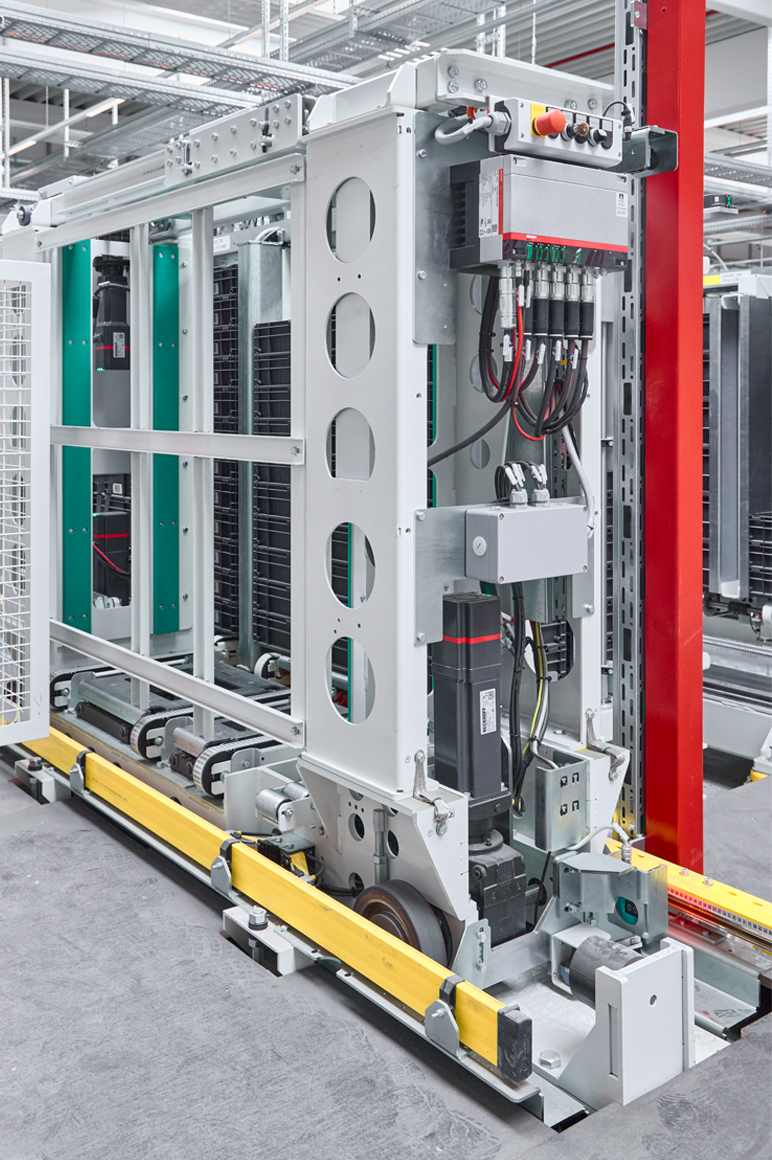
The plan was to automate material replenishment within the system so that manual intervention would no longer be necessary and the high degree of product variance could be managed in a confined space. The result is a slim shuttle system with dimensions of around 2 m by 60 cm. It supplies the robots in the assembly stations with the right side and rear panels for the respective drawer. Three such shuttles are installed in each two-line system. They collect the components in stacked trays and transport them reliably to the correct station over a distance of around 20 m. When loaded, the shuttles weigh approximately 1,000 kg. Despite their weight, they achieve speeds of 100 m/min and a margin of error of less than 1 mm.
New paths for automation
Hüttenhölscher originally considered integrating the shuttles into the system via energy chains. However, this approach could not be implemented within the very narrow supply corridors of the space. The required dynamics would also not have been achievable over the long distances to be traveled. A different solution therefore had to be found. The system manufacturer supplied the mobile system with 400 V via a busbar. As a result, both the two travel drives and the three axes for picking up the stacks of trays are electric. Pneumatics were completely dispensed with in the shuttle.

For communication, the decision was made to use a wireless connection and the EtherCAT Automation Protocol (EAP), which allows highly deterministic communication between EtherCAT masters. “As EAP can also be used to transmit safety signals, the wireless solution meets even the high safety requirements of the various protection zones in the application,” says Julius Polldavid from Beckhoff Systems Engineering, describing the new solution. “Without this protocol, an implementation of this nature would not have been possible.”
The shuttle’s control tasks are performed by the fanless C6025 ultra-compact Industrial PC, which measures 82 x 127 x 50 mm. “Due to the small footprint, the slim design was the decisive criterion,” continues Andreas Sträter, who also works in the Systems Engineering department at Beckhoff. “As a result, the shuttle works with just a slim control box. In terms of performance, the C6025 is perfectly adequate. This is because the logic functions are not calculated on the shuttle itself.” “This takes place, including the safety functions, in the higher-level system controller – a Beckhoff C6930 control cabinet Industrial PC,” says Julius Polldavid. “The shuttle’s control system only executes the logic functions, collects I/O signals, and provides feedback. This is also why the mobile part of the system does not need its own human-machine interface.”
Smart, integrated drive technology
For Mr. Kellner, choosing the IPC manufacturer was an easy decision: “On the control side, PC-based control and EtherCAT from Beckhoff is the standard in the furniture industry. The growing drive portfolio is also very popular in the sector.” In this case, the fact that Beckhoff also offers integrated solutions was essential when it came to making the choice. “There was simply no room for classic servo drives in the shuttle control box,” says Andreas Sträter, “and the installation space for the motors was also very limited.”
Because the drives of the AMP8000 distributed servo drive system are integrated directly into the compact motors, the distributed drive system that Beckhoff uses to cater to modular machine concepts proved to be ideal for the shuttle solution. The AMP8031 distributed servo drive is used to handle the trays, while the AMP8552 variant with increased rotor moment of inertia is used in the travel axes. The AMP8620 remote power supply module is designed for five axes – so it is also perfectly suited to this application at nobilia. The EtherCAT P one cable solution saves even more space. The pre-assembled cables meant that very little wiring work was required. Another advantage of the integrated solution is that the drives can be replaced by the maintenance technician if necessary. No intervention in the programming is required. The AMP drives with integrated safety functions such as STO, SLS, or SS1 also meet all requirements in terms of safety technology. The design is carried out in the usual Beckhoff engineering environment with TwinCAT Drive Manager.
Assembly and testing carried out in advance
“We ventured into uncharted technical territory with the mobile shuttle solution, including with wireless communication and distributed drive technology,” summarizes Mr. Kellner. “We had no comparative values to fall back on and no reference system either.” This made it all the more important for the system manufacturer to gain as much experience as possible before carrying out the installation and commissioning work at nobilia. For this reason – and in order to meet nobilia’s ambitious schedule for converting the system – the shuttles were assembled and tested in full at Hüttenhölscher. “As a result, we more or less just had to put them on the rail in Plant 2,” concludes Mr. Kellner. The new drawer systems have been in regular operation in the two nobilia plants since January 2025. “Given the size of the project, the conversion of the production facilities to the new range was more than a success,” concludes David Müller.


