European industry is undergoing a transformation. New climate targets as well as uncertainties and price increases with regard to fossil fuels are increasingly accelerating the energy transition that has already begun. Initiatives such as the All Electric Society call for and promote the electrification of all industries. The pressure on industrial production is also increasing.
The energy transition is not only about electrification, but also about ensuring that electricity comes from renewable resources. The European Union’s target is for renewable energies to account for 42.5% of total energy consumption in the EU by 2030. The associated expansion of generation capacities, grid infrastructure, and system integration, however, requires substantial investment, which is also reflected in electricity costs. According to German comparison portal Strom-Report, Europe’s average electricity price is 28.7 euro cents/kWh, putting it way above the industrialized nations of China (6.95 euro cents/kWh) and the USA (18.14 euro cents/kWh) in an international comparison. At 39 euro cents/kWh, Germany ranks fifth in the world for the most expensive electricity prices.
This development, combined with the shortage of skilled workers, is a particular burden and challenge for companies in the energy-intensive process industry. It is not uncommon for plants or entire sites to be closed as a result. Effective measures are needed to ensure the long-term competitiveness of the German and European process industries. One approach is the systematic digitalization of production facilities and the associated infrastructure. First of all, this enables processes to be monitored and optimized, thus saving resources. Secondly, networking generators and loads allows the distribution of electrical energy across the production site to be controlled in a predictive manner. Initiatives such as NAMUR’s Process X also aim to strengthen the networking of companies for the intelligent exchange of raw materials. Surplus energy in the form of electricity, but also hydrogen or steam, is set to be offered on a digital marketplace and available for other companies on site to access.
Such approaches are based on complete and up-to-date data. This involves, for example, process data from the plants, current energy consumption, capacity utilization of generators, and possible outages and problems in the electricity grid – data volumes that are currently not yet available. This data also needs to be processed and analyzed, ideally in real time and taking data protection measures into account.
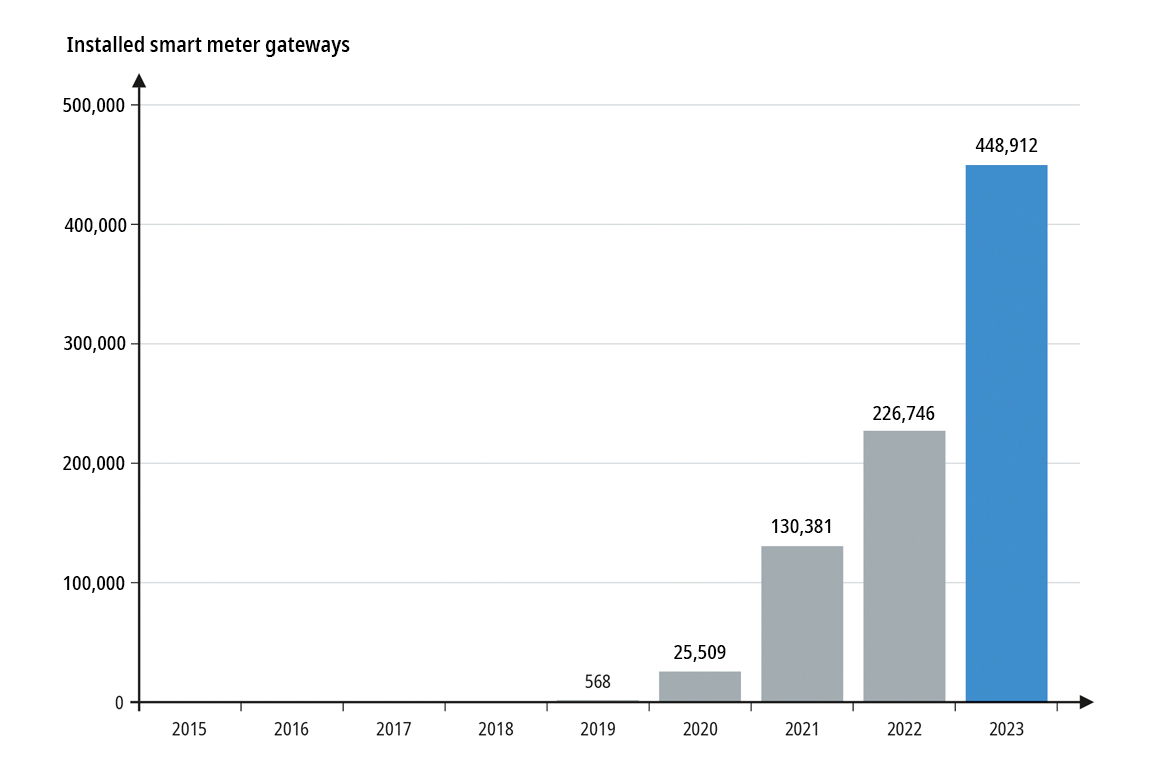
Smart meter gateways are increasingly being used to record the data.
Smart meters are intelligent, communication-enabled electricity meters. They record the current energy consumption and recovery of a building or plant and transmit the data to key players such as metering point operators, grid operators, and energy suppliers. This means that consumption can be recorded precisely, billed flexibly, and the resulting savings potential identified. The available energy can also be distributed intelligently. The electricity grid is becoming a smart grid.
But why should intelligence be limited to the electricity grid? Numerous other energy sources are used in industrial applications in the chemical and pharmaceutical industries in particular. Gas, steam, and hydrogen can also be supplied, distributed, and used intelligently. Similar to the smart grid, this creates a holistic energy system in which current consumption and available quantities are recorded transparently. If pressure, flow rate, temperature, and other process variables are recorded and analyzed in addition to current and voltage values, comprehensive efficiency and optimization potential can be uncovered.
The necessary measured values can be recorded by installing remote terminal units (RTUs) in power plants, distribution points, and systems. RTUs consist of an intelligent head station with corresponding software and various physical connections for integrating sensor data from the field. Their core task is to feed all physical measured variables into digital communication networks. To do this, the data often has to be transmitted over long distances. RTUs should meet the requirements of the industry and therefore also be able to be used under adverse conditions such as high temperatures, vibration, or explosive atmospheres.
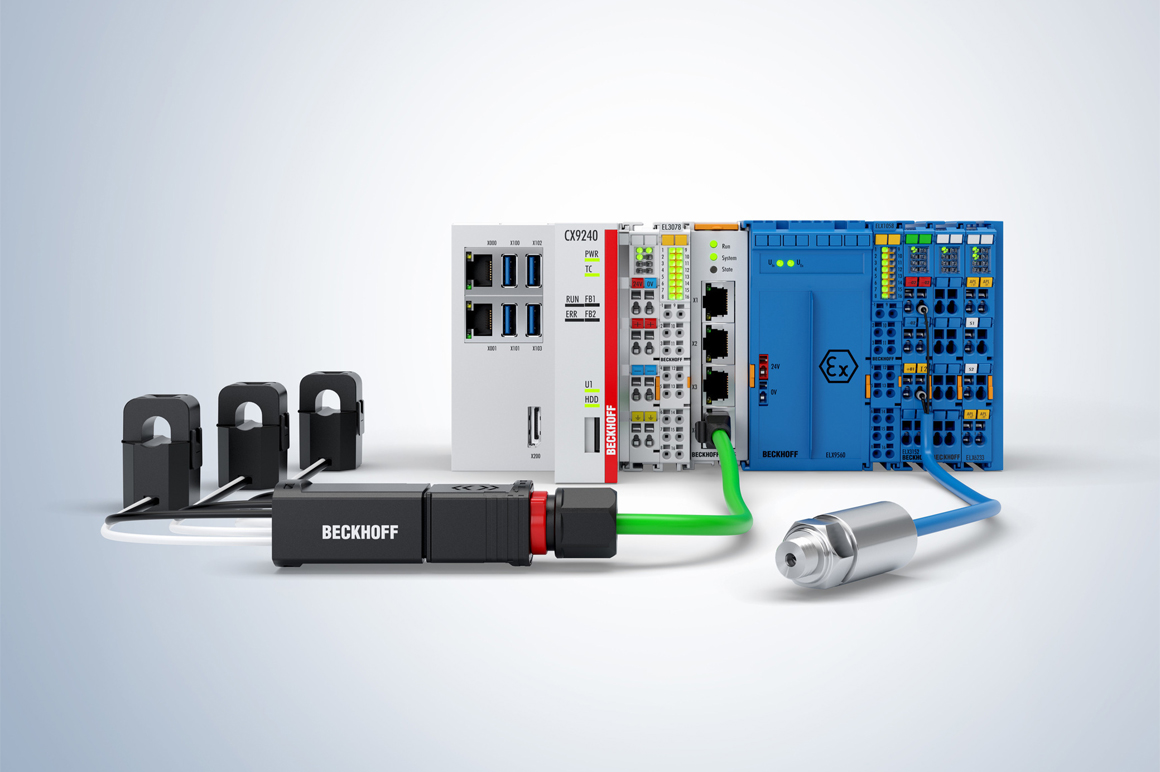
With the automation range from Beckhoff, RTUs can be implemented to record all relevant measured variables. CX-series Embedded PCs, TwinCAT automation software, and EtherCAT Terminals for signal acquisition are used. The wide I/O spectrum allows the complete integration of all electrical and process signals from the field. The modularity of Beckhoff components enables RTUs to be assembled flexibly and specifically adapted to the respective application or measurement task.

Recording and calculating electrical energy
According to ZVEI, electricity accounts for around 30% of the energy required in industry. With many years of experience in the wind industry, Beckhoff offers comprehensive solutions for power measurement and control. To integrate these into the existing electricity grids of the process industry, the portfolio includes easy-to-retrofit split-core current transformers from the SCL series. The measurement system, consisting of three 333 mV split-core transformers, can be connected directly to the EL3475 power measurement terminal via an RJ45 interface. The EtherCAT Terminal automatically detects the connected SCL transformers and sets the corresponding ratios and characteristic values. This means that all relevant electrical data in a distribution grid can be recorded without any configuration work.
The measured values supplied can then be further processed and evaluated by the TwinCAT Power Functions. For example, modules are available to perform real time-optimized calculations of RMS values, harmonics, or other variables. Frequency determination methods and an instant Clarke/Park transformation are also included. A power generation plant controller can also be implemented in accordance with the relevant standard. All modules have standardized interfaces so that results can be integrated into higher-level systems quickly and easily.
Recording non-electricity-related process data
In addition to electricity, the industry obtains the energy it needs via various other media. For example, water, natural gas, and hydrogen serve as important foundations for energy-intensive processes. In order to monitor consumption and recovery in line with the Process X concept, aspects such as pressure and flow rate have to be measured. Corresponding field devices are usually integrated via a 4–20 mA loop. Analog EtherCAT input terminals such as EL3182 or EL3184 are available in the Beckhoff portfolio for this purpose. These also enable communication with the field devices via the familiar HART protocol. This allows sensors to be parameterized and maintained. In addition, Ethernet-APL is already an integral part of the terminal portfolio as a future industry standard. APL-capable field devices can be integrated in modules using the EL6233. If the environment requires it, the connection can also be made intrinsically safe via the ELX-series terminals with integrated safety barrier.
Field device maintenance and servicing
Remote access to both the RTU and the connected field devices is essential to reduce commissioning and maintenance work. Technologies such as HART and Ethernet-APL offer options for this: Firstly, the sensors can be accessed via tools such as FDT/DTM, FDI, or the web server in the case of APL devices. Secondly, the additional parameters can be transferred cyclically and with standardized information models to asset management systems. The necessary function blocks are also available in TwinCAT for this purpose. This approach is described in detail in NAMUR Recommendation 175: NAMUR Open Architecture.
Data forwarding to central systems
Networking the distributed stations is a challenge simply because of the distances that need to be bridged. For example, fiber optic connections can be used to protect against electromagnetic interference over long distances. OPC UA and telecontrol protocols developed by and for the wind industry have established themselves as communication protocols. With TwinCAT, Beckhoff offers functions for programming data models in accordance with IEC 60870 or IEC 61850. Software blocks for communication via OPA UA are also available. New digitalization concepts such as the Module Type Package (MTP) can also be used to integrate the distributed stations into a higher-level control or monitoring level. A station provides its functions in the form of services. These services can then be called up by a control system. The MTP standard therefore represents a further level of abstraction between the actual measured values and the evaluation unit. The TwinCAT automation software also features numerous modules for MTP integration.
Management of distributed systems
New software updates will be necessary at regular intervals during the service life of the RTUs. For one thing, legal regulations regarding calculation may change. What’s more, new functions will need to be implemented. Containerized applications, which can be implemented with Linux®, are a logical option to enable these changes to be installed quickly and easily. With the CX8290 or CX9240, Beckhoff offers Linux®-based embedded PCs that are particularly suitable for use in RTUs. Systems familiar from the world of IT carry out the administration and management of software containers and distribute them to the stations. TwinCAT can also be used with the functions as a container application.
Application examples
RTUs offer a wide variety of application options. They can be used in networked industrial buildings to analyze energy consumption and uncover potential for optimization. Heating and ventilation systems as well as water and electricity consumption are particularly relevant here. All measured values are brought together in a central control system for each building and calculated accordingly. The consumption data is then passed on via industrial protocols such as BACnet or Modbus.
Another use case results from the approach presented by NAMUR: Process X. The consumption and feed-in values of the plants at a chemical site can be evaluated across all manufacturers. Excess energy from one production step, e.g., process heat or chemical gases, can be directly coupled into other consuming processes. Linking the plants and current measured values via a central level known as the data room is essential for this.
Finally, the increasing numbers of installed smart meters mentioned above show how important the monitoring of electricity and gas grids is becoming. Generators, distribution stations, and loads: All components of an energy grid should be networked and monitored. These variables must be monitored not only in the general network, but also within a chemical park.
As diverse as the applications and measured values to be recorded are, the modular Beckhoff portfolio allows suitable RTUs to be set up for every scenario. The data is recorded securely, processed appropriately, and passed on. The openness of PC-based control offers a major advantage here: The diverse interfaces not only enable all common measuring signals to be recorded, but also the data to be forwarded easily to central systems. Beckhoff technology is therefore also ideally suited to retrofit projects such as those that will be necessary to establish smart grid structures in the process industry.