Compact and exceptionally gentle filling of a wide variety of product containers
Rotzinger PharmaPack designed its VarioFill filling and capping platform to meet three key customer requirements: high flexibility to accommodate a broad product range, a highly compact machine design, and especially gentle, impact-free handling to ensure even the most sensitive containers can be filled. The core element – and foundation for this high-performance system concept – is the XTS linear transport system from Beckhoff.
Rotzinger PharmaPack in Waiblingen specializes in turnkey packaging systems for the pharmaceutical industry and increasingly for the cosmetics industry, too. As Product Manager Michael Gensheimer explains, “Our new VarioFill system in particular is especially well suited to filling creams and lotions, thanks to the exceptionally gentle product handling provided by XTS.” As a member of the Rotzinger Group, the company also benefits from the Group’s broad application expertise across a wide range of projects. If required, VarioFill can moreover be expanded with the pickFeeder container infeed and unscrambling system from Spanish sister company Packfeeder, which is likewise based on XTS.
VarioFill was designed with a highly flexible platform in mind for filling a wide variety of products and capping the corresponding containers. It is designed for non-prescription, non-aseptic pharmaceuticals such as nasal sprays and eye drops, as well as for liquid and solid products from the cosmetics, personal care, and food industries. Michael Gensheimer highlights one particularly important aspect, “VarioFill combines a very high degree of flexibility with the smallest footprint currently available in this segment of primary packaging.”
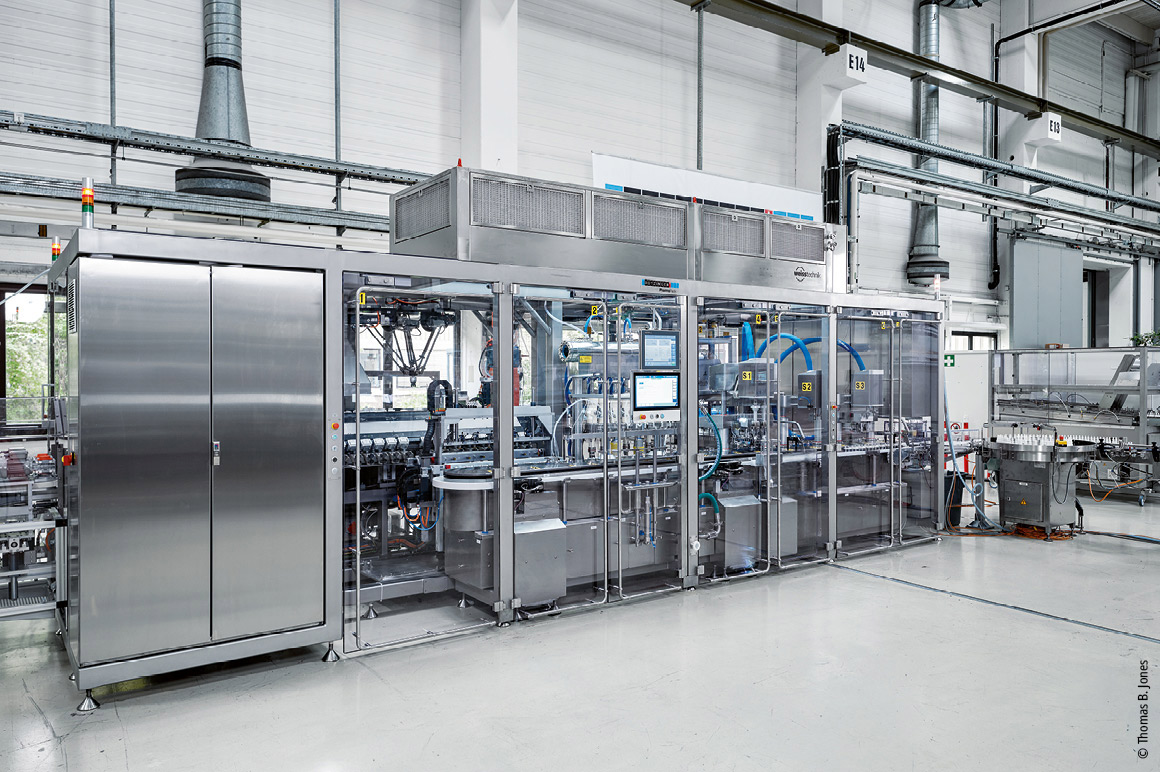
Complex process sequences in an ultra-compact design
The process begins with container supply, integrated as the appropriate infeed solution for the application in question – for example, upright glass bottles or plastic bottles in bulk. This is followed by an air-rinsing module that uses filtered air and vacuum suction to ensure thorough, hygienic cleaning inside each container to be filled – usually small bottles. The containers are then filled either with liquids or with products in solid oral dosage form:
- For precise filling of liquid products with viscosities ranging from low to high and fill volumes from 1 to 160 ml, the filling station can be equipped with various dosing technologies, such as rotary piston or hose pumps, using tool-free quick-change nozzles. To ensure maximum product integrity, the containers are also purged with nitrogen before filling, reducing oxygen exposure and thereby preventing oxidation and spoilage.
- For products in solid oral dosage form, such as tablets, coated tablets, and capsules, one or more counting modules can be integrated. Fast, tool-free format changes are also possible here, and multiple capping units can be incorporated while maintaining the same compact footprint.
The filling process is fully monitored by in-process control. As Michael Gensheimer explains, the XTS linear transport system also allows a checkweighing function to be integrated in an exceptionally compact design: “XTS transfers the containers to a short conveyor belt with an integrated weighing function both before and after filling. This makes it possible to reliably verify the correct fill quantity for each individual container. It also highlights a major advantage of XTS, in that the movers remain uniquely identifiable in the control system throughout the entire product transport process. This means that each individual container and its correct filling can also be traced reliably. XTS also enables precise synchronization with the conveyor belts of the weighing unit, making it possible to implement an extremely compact scale.”
Once the containers have been filled correctly, they can be fitted with the appropriate type of caps or lids at one or more freely configurable capping stations, depending on the application – including snap-on, screw, pump, and crimp closure. Here, too, flexible product transport with XTS offers clear advantages according to Michael Gensheimer, since the movements of the capping head are significantly more efficient than with conventional container infeed systems such as screw conveyors. XTS is the heart and pace-setter of the system, he adds, because it allows the individual machine modules to be operated in the optimum way for each filling order. This results in high overall efficiency and, in turn, maximized system output.
Together with the special capping process, which is based on one capping station each for placement or snap-on application and for additional crimping or screw-on closing, XTS makes it possible to achieve a machine design with a minimal footprint. As Michael Gensheimer explains, “A system in conventional design would be about twice as long as our VarioFill.”
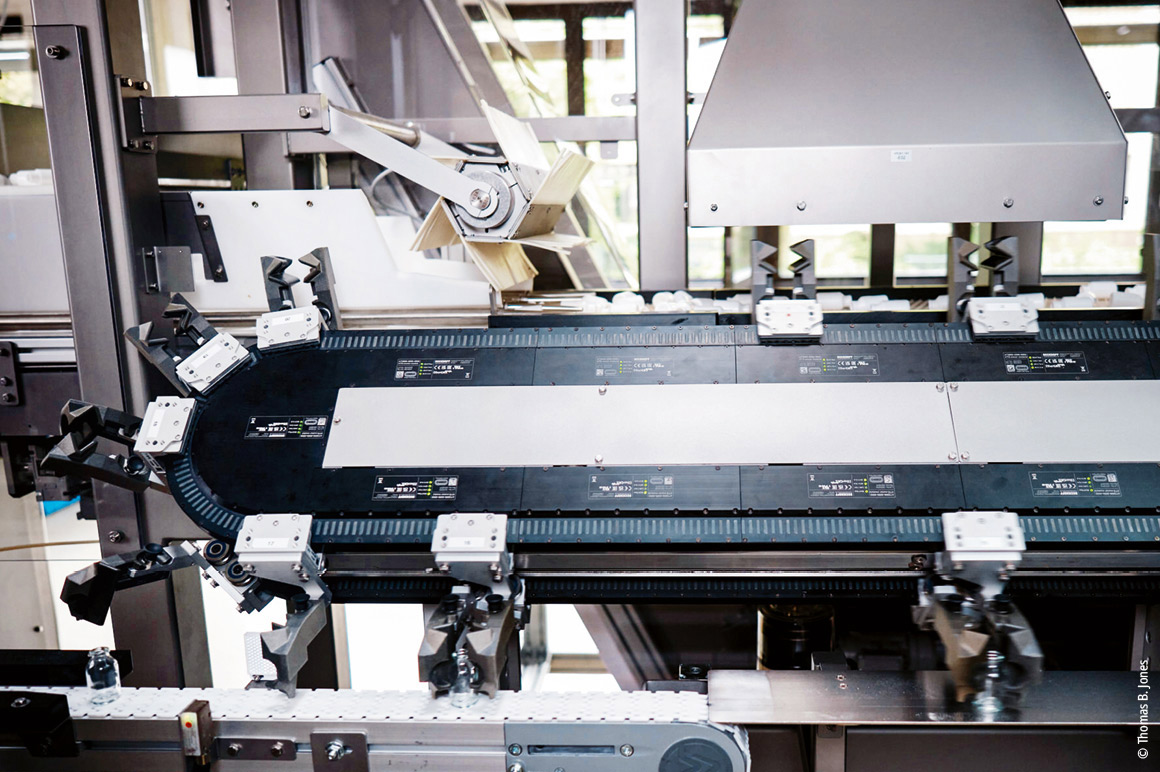
Flexible and gentle container handling with XTS
The modular transport system from Beckhoff allows VarioFill to be tailored precisely to specific customer requirements. Configured as a closed oval, the system can be extended to the required length in increments of 50 cm – with twelve movers per segment – typically ranging from 1.5 to 4 m. Beyond this flexibility, Michael Gensheimer sees another major advantage in the fact that XTS enables impact-free and therefore exceptionally gentle transport of a wide variety of container geometries, “Conventional handling via conveyor belts or screw conveyors would pose a risk of scratches and other damage, especially with glass vials, due to the containers bumping into one another. XTS eliminates this completely, because the containers are picked up gently and with defined pressure by the gripper – implemented with two synchronized movers – and reliably separated.”
Michael Gensheimer adds that changeovers for product switches are much faster than with conventional systems, since they can be implemented easily via software and, if necessary, only the gripper elements need to be replaced. He also sees a further advantage in Beckhoff’s PC-based control technology, in that it simplifies the database integration used to store the comprehensive process data in a monitoring database.
PC-based control as a modular, integrated system
As Michael Gensheimer explains, PC-based control gives Rotzinger PharmaPack the advantage of being able to integrate all required functions in a modular way, “In addition to universal PLC and motion control, TwinCAT also enables real-time communication, TwinSAFE, and data acquisition and analysis in one consistent, high-performance, and highly flexible system. This modularity and system openness also extend to the broad range of control hardware.”
A CX2072 Embedded PC serves as the control system for VarioFill, complemented by a C6030 ultra-compact Industrial PC and a CP3918 multi-touch Control Panel for HMI functions. If requested by the customer, a C6015 ultra-compact Industrial PC can also be used where a separate device for remote access to the system is required. At the I/O level, Michael Gensheimer highlights the IP67 EP series I/O box modules, which can be used decentrally and, with their wide signal variety, cover all I/O requirements.
The AX8000 multi-axis servo system controls the rotary servo axes via Beckhoff AM8000 servomotors featuring One Cable Technology (OCT) designed to save space and materials. Depending on the system configuration, this makes it possible to implement around 20 to 40 axes, for example for rotating the containers during air rinsing, operating the grippers, and performing other movements within the various workstations.
Further information


