With over 500 I/O points and intrinsically safe terminals, Greenlight Innovation revolutionizes hydrogen testing by ensuring comprehensive safety and seamless modular control. This advanced setup allows for precise monitoring and management of complex hydrogen processes, enhancing both reliability and efficiency in testing operations.

As the world increasingly looks to hydrogen as a clean energy solution, the companies developing these technologies face a critical challenge: safely and accurately testing their innovations before they reach the market. Greenlight Innovation, headquartered in Burnaby, British Columbia, has emerged as a global leader meeting this need.
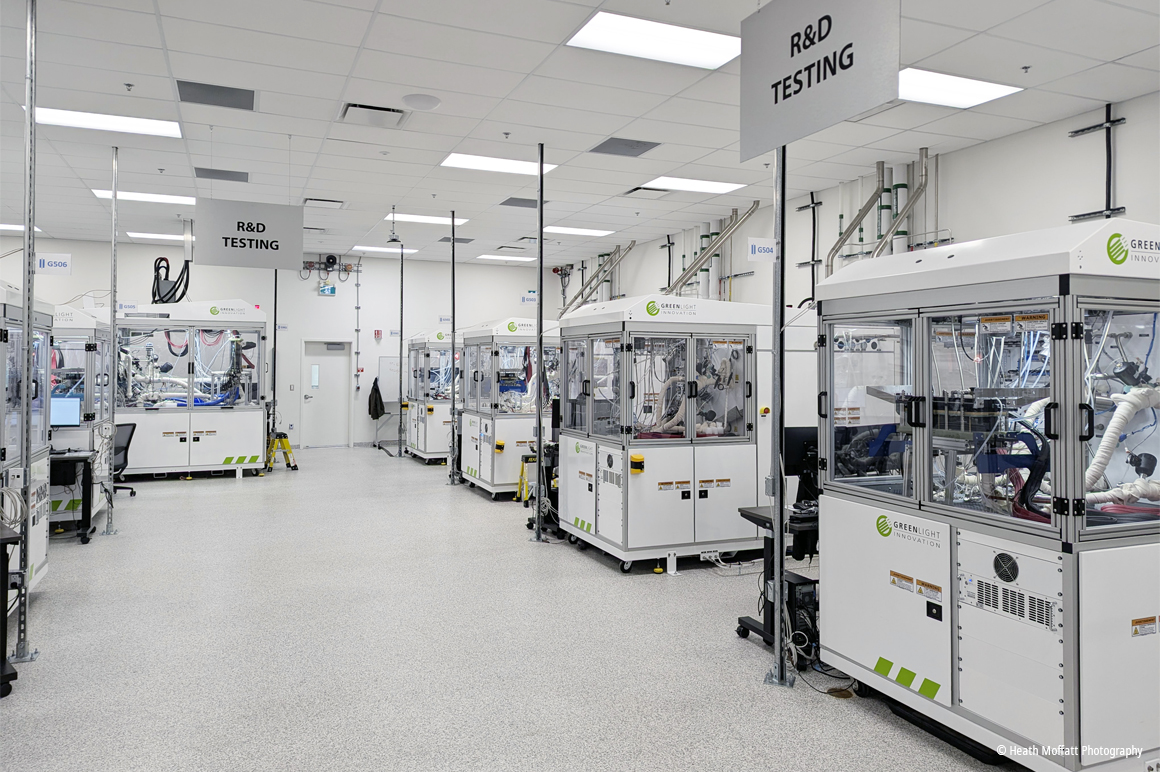
Founded in 1992 as a supplier to the fuel cell industry, Greenlight was reborn in 2008 when a core team restarted the company with a vision to provide advanced test equipment for emerging energy technologies. This vision has transformed into a thriving operation that today employs approximately 300 people across two factories, producing 150-200 sophisticated test systems annually.
“Our goal is to support our customers in getting their product to market as fast as possible,” explains Christian Bosio, Managing Director at Greenlight. “We're enabling our customers with the accurate testing tools they need to commercialize their technologies and succeed.”
In recent years, Greenlight has strategically expanded into electrolysis testing. “Electrolysis has become a major focus,” says Greig Walsh, Chief Commercial Officer at Greenlight. “As the hydrogen industry evolved, we saw increased demand for equipment to test hydrogen production technologies. The market has shifted toward green hydrogen production, creating a new market for our test systems.”
Navigating complex hydrogen testing with a reliable control platform
Among Greenlight’s product portfolio are test stations for industrial-scale electrolyzers - systems that split water into hydrogen and oxygen using electricity. Their largest systems, capable of testing four-megawatt electrolyzer stacks, represent their most complex engineering challenge.
“The equipment is very complicated and technologically demanding,” said Bosio. “That machine has thousands of components that we're putting together, and it has to work as one. Everything has to be top-notch, very high quality, and reliable.”
These test stations must control high-pressure gases up to 50 bar, regulate temperature across multiple zones, and manage potentially explosive hydrogen-oxygen mixtures—all while ensuring continuous operation with minimal operator intervention. With systems containing as many as 500 I/O points and multiple communication protocols, Greenlight needed a control platform offering exceptional flexibility, reliability, and comprehensive safety capabilities.

Among these requirements, safety presented the most demanding challenges. “Electrolyzer test equipment operates at higher pressures, so the safety requirements are significant,” Bosio said. “As we get into these megawatt-class systems, the safety requirements have been compounded, making safety a critical factor in all of our designs.”
The technical demands were further complicated by varying international safety standards and customer-specific requirements. Greenlight's systems needed to support different safety protocols depending on deployment location while maintaining the same high performance standards.
Standardizing on Beckhoff hardware for flexible automation
Before finding the right control platform, Greenlight overcame a number of specific challenges, including struggling with bulky I/O modules and communication reliability issues with their previous systems.
After careful evaluation of various control platforms, Greenlight selected Beckhoff Automation technology for all their systems. The decision was based on both technical and business considerations.
"We were very conscious that this equipment needs sophisticated electronics and control systems, so we wanted to make an educated choice at the beginning," explains Walsh. "We did some analysis of the existing components we could purchase, and Beckhoff was a very good fit for us, allowing us to scale. They’ve got very flexible products and good customer service and support, which pairs nicely with Greenlight."
Kriss Koutzarov, Electrical Engineer at Greenlight, highlighted the technical advantages that drove their decision: “The modularity and flexibility were key factors. With Beckhoff, we had different options for I/O module channel density. Also, each module was very compact—they were just half an inch compared to five inches with other solutions. As a result, we managed to save a lot of space in the cabinet. Everybody just loved it because it was so easy and flexible. This is when we decided to start building our stations modularly.”
To connect the hundreds of sensors, valves, and controls needed in their systems, Greenlight uses various EtherCAT input/output terminals throughout their machines. These terminals handle everything from basic valve control to sophisticated analog measurements, with systems often incorporating up to 500 I/O points. This modular approach allows Greenlight to easily add or modify capabilities as project requirements evolve.
Building on the safety challenges mentioned earlier, Greenlight implemented Beckhoff's TwinSAFE terminals to create comprehensive safety systems. The TwinSAFE architecture integrates digital inputs through EL1904 and EL1918 terminals and digital outputs via EL2904 and EL2912 terminals, providing Safety Integrity Level (SIL) 3 protection. Moreover, the system utilizes TwinSAFE SC terminals to monitor analog parameters such as temperature, pressure, and other critical parameters to ensure safe operation under all conditions up to SIL 2 level.
For areas with potential hydrogen exposure, Greenlight uses Beckhoff's ELX intrinsically safe terminals. These specialized terminals integrate isolation barriers and remote I/O modules in a single compact housing, eliminating the need for external barriers while enabling direct connection to field devices in hazardous environments up to Zone 0/20.
“Wherever there might be fuel and oxidant, we must eliminate the ignition source. The ELX terminals' outputs don't have the energy to cause a spark, even if you shorted them,” said Koutzarov.
The ELX terminals provide significant space and cost advantages for Greenlight's systems. With up to eight intrinsically safe inputs available in a compact 12 mm housing, they eliminate the need for external barriers, reducing control cabinet space requirements. Certified for ATEX, IECEx, and NEC/CEC, these terminals meet all industry-specific guidelines for explosion protection and support Greenlight's global deployments.
Simplifying software development with TwinCAT and PC-Based control
At the heart of their four-megawatt electrolyzer test station is the CX5130 embedded PC, which manages the entire automated testing process. With its dual-core processor and fanless design, the CX5130 provides the ideal balance of computing power and reliability for Greenlight's demanding industrial environments. This compact PC-based controller handles everything from data acquisition to complex control algorithms while offering the connectivity needed to integrate with their extensive I/O network. The CX5130's ability to perform PLC and measurement tasks simultaneously makes it particularly well-suited for Greenlight's sophisticated test sequences, where precise timing and coordination are essential.
“Having a reliable, trustworthy I/O system is critical to the function, performance, and safety of the machine," explained Bosio. "We make a premium product, and that's why we're happy with Beckhoff being part of that solution."
The system architecture leverages TwinCAT automation software for process control and the EtherCAT industrial Ethernet system for seamless integration.

“It's just plug and play, which is amazing,” said Christian Bordin, Automation and Controls Developer at Greenlight, explaining the advantages of EtherCAT’s simplicity. “There’s no need for writing complex drivers. With the TwinCAT engineering environment, we can easily configure the system and communicate with all our components."
Keeping pace with hydrogen growth through modular standardization
The impact of Greenlight's standardized Beckhoff control platform has been significant for both the company and its customers. Their test stations now provide comprehensive data collection and analysis capabilities that enable manufacturers to validate and improve their designs.
One such customer, cellcentric, has found Greenlight's test stations invaluable for their fuel cell development, allowing them to evaluate performance under varying gas flow rates, humidities, temperatures, pressures, and electrical loads. Using Greenlight's Emerald software, they can develop and execute automated test scripts, view real-time data, and log precise instrumentation outputs—providing fast and reliable feedback to validate design changes and ensure product quality before shipment.
Looking ahead, Greenlight is focused on standardizing its electrolyzer test systems across a wider range of sizes. “The near-term evolution for electrolyzer test rigs is to standardize that product line,” explained Walsh. “Once they're standard, we don't need as much engineering on the project level, and we can achieve much faster delivery times for our customers.”
As Greenlight continues to scale, their approach remains consistent: deliver flexible, high-performance systems that let customers focus on their core technologies while Greenlight handles the complexity behind the scenes.
“We take what we know—process equipment, electrical design, software, SCADA—and we deliver a complete solution. That’s what our customers rely on, and that’s what we’ll keep doing as this industry evolves,” Bosio said, adding that consistency, safety, and repeatability aren’t just features —they’re requirements. “The key to our success has been adaptability, which allows us to meet the changing needs of this growing industry,” he said.
Further information


