EP7402 EtherCAT Box modules in warehouse and distribution logistics
Conveyor technology is part of the critical infrastructure of every logistics company. This is why the logistics service provider Arvato SE has completely retrofitted the central conveyor line between several warehouses and the order picking area at its Harsewinkel site. With PC-based control, One Cable Automation, and around 200 EP7402 EtherCAT Box modules with integrated MDR controllers from Beckhoff, the system runs much more efficiently, quietly, and reliably.
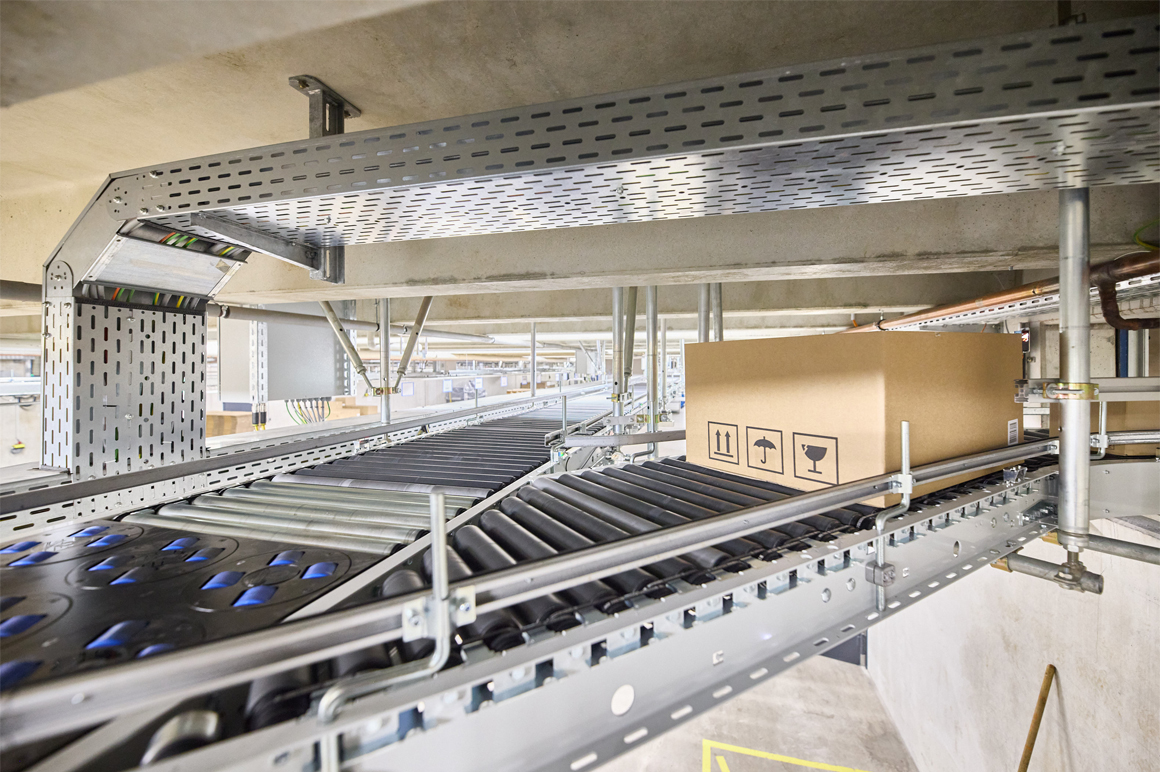
As a global logistics company, Arvato SE, headquartered in Gütersloh, handles all B2C and B2B logistics processes for its customers, from order acceptance and value-added services to returns management. Represented at over 100 locations worldwide, Arvato maintains warehouse capacities of almost 1 million m² at 28 locations in Germany alone, including several halls with high-rack warehouses at the Harsewinkel site near Gütersloh. From here, orders are picked for customers from various industries, then the goods are packed and shipped to the recipients. The high-rack warehouses are connected to the picking area by a central circular conveyor line measuring over 250 m in length.
24-V technology for more efficient operation
The ring’s previous conveyor technology was still based on roller drives with three-phase motors. “These drives were very loud, ran continuously along the entire route, and were prone to failure after around 20 years of operation,” says Markus Wolharn, Senior Expert Engineering at Arvato. The conveyor technology has therefore been renewed with a mechanical and electrical alternative: 24-V roller motors have now replaced all the old drives. They are controlled via a total of 186 decentralized EP7402 EtherCAT Box modules with integrated MDR controllers (MDR = motor driven roller). At the same time, the existing control hardware was converted to a C6030 ultra-compact Industrial PC, the software was migrated from TwinCAT 2 to TwinCAT 3, and the existing system visualization was adapted.
The mechanical conversion of the conveyor line was designed and realized by Budde Systems in Schloss Holte-Stukenbrock. To speed up the conversion work on site, the conveyor line was divided into 125 individual segments, which were completely pre-fabricated and pre-wired at Budde Systems. “This modular production concept saved us a lot of cabling effort and time during final assembly at Arvato,” explains Maximilian Budde, managing director of Budde Systems.
The advantages of One Cable Automation
The prerequisite for this modular approach is the EtherCAT Box module connection technology using M8 connectors for the sensor technology and roller drives as well as ENP hybrid connectors (B23) for connecting power and EtherCAT communication. “This enables a fast and fail-safe connection,” enthuses Stefan Maßmann from Beckhoff systems engineering, emphasizing one of the advantages of One Cable Automation (OCA). The Budde Systems mechanics only had to lay the pre-assembled hybrid cables between the MDR controllers in the individual segments on site and connect them to one of the power supply control cabinets.

To keep the cable lengths to the EP box modules short, a total of 27 control cabinets are distributed throughout the system to supply power to the roller drives. “Each control cabinet supplies several segments and is positioned in the middle to keep the DC voltage drop low,” emphasizes Stefan Maßmann. The input voltages on the EP box modules were evaluated during commissioning, showing that this approach works. There was only case concerning a roller drive where the output voltage of the corresponding PS3031 power supply had to be adjusted slightly.
Each ring conveyor segment has one or two roller drives and the corresponding sensor technology to activate the drives. The switches also have a barcode scanner to identify the packages. All sensors are recorded via the EP box module I/Os. If required, additional I/O modules or other EtherCAT devices can be connected via the integrated EtherCAT junction. “This was the case, for example, with the switch supplier’s roller drives and the barcode scanners,” explains Stefan Maßmann.
Increased flexibility with PC-based control and OCA
“One Cable Automation and the IP67 box modules offer much more flexibility in terms of future system expansions,” says Markus Wolharn, picking up on another important aspect of the cabling philosophy. If the system needs to be modified, the simple connection technology and pre-assembled cables make this just as easy in terms of control technology as the mechanical conversion. The system also demonstrates its advantages when it comes to maintenance. “The HMI shows the troubleshooting service exactly which segment is blocked and which component may need to be replaced,” explains Markus Wolharn.
When transporting the packages, the individual conveyor segments are switched on or off depending on the destination and whether the next segment is occupied. “When the path is clear, the next two transport segments are always switched on to ensure smooth and fast transportation,” explains Dimitri Kool from Beckhoff systems engineering. By the time the package reaches the next conveyor, it has already reached its target speed and the package moves on without losing time or jerking. In practice, each package creates a zone of active conveyors that moves through the ring.

Efficient engineering through variant management
Logistics operations had to be resumed quickly during the ten-week conversion period. This requirement was met by splitting the project into two sections. To this end, the first part of the modernized conveyor technology – which is a high priority for warehouse logistics – was put into operation with a C6030 ultra-compact Industrial PC and TwinCAT 3. At the same time, the second and larger part of the conveyor technology was automated on an old PC.
Finally, both software projects were merged on the C6030 ultra-compact Industrial PC. “With variant management in TwinCAT 3, we were able to achieve this efficiently and work permanently with an overall project in the Git repository,” says Stefan Maßmann.
The TwinCAT 2 controllers that are still in operation in the connected warehouses presented a challenge. TwinCAT 3 contains prepared data structures that map an EP box module with all variables and significantly speed up configuration. To be able to use this in the configuration of the modernized system parts under TwinCAT 2, this data structure was implemented as a function block for TwinCAT 2 and then migrated back to TwinCAT 3. “This had the advantage of working with identical variable names everywhere and exchanging the program parts between new and existing controllers as required when updating,” emphasizes Stefan Maßmann. “These global data types for TwinCAT 2 and TwinCAT 3 have significantly accelerated the project planning of the approximately 200 MDR controllers with around 50 signals each,” says Jürgen Bolte from Beckhoff systems engineering.
More packages, less energy consumption
The retrofit has not only increased reliability, but also the possible throughput from 2,000 to 3,000 packages or transport containers per hour – with significantly quieter operation and lower energy consumption to boot. “The 24-V technology also ensures greater safety if manual intervention is necessary in the event of a jam,” says Markus Wolharn. As a reference project, the ring conveyor conversion is attracting interest in other Arvato departments and locations due to its energy efficiency and lower noise emissions during operation. For Markus Wolharn, however, the advantages of One Cable Automation and the EP box modules when adapting the conveyor technology and installation are equally valid arguments.